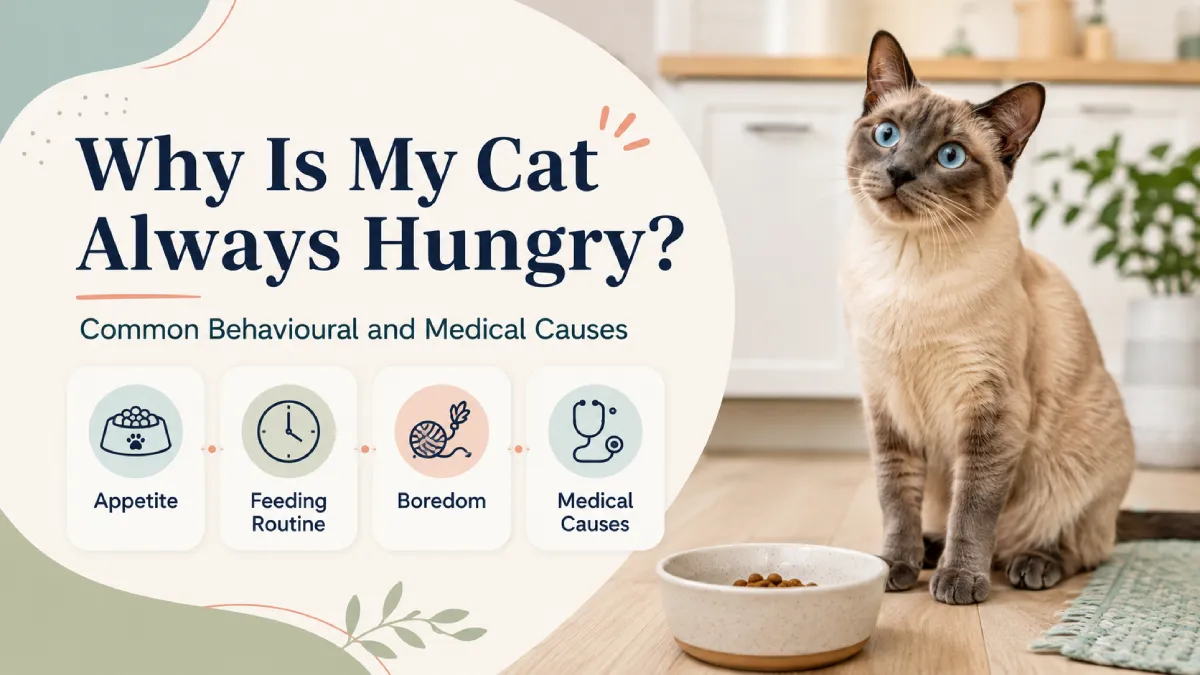
Why Is My Cat Always Hungry? Common Behavioural and Medical Causes
Why is my cat always hungry? Sometimes the answer is related to feeding routine, portion size, calorie density, food competition or learned food-seeking behaviour. But a genuine increase in appetite—called polyphagia—can also occur with medical problems, particularly when hunger appears alongside weight loss, increased thirst or urination, diarrhoea, vomiting or other changes. Hyperthyroidism and diabetes are two important examples veterinarians may investigate.
Before increasing the food bowl, work out how much your cat actually eats in 24 hours and compare appetite with weight, body condition, water intake, urination, stool and activity. Feeding history is useful veterinary information because appetite changes need to be interpreted as part of the whole cat, not as an isolated symptom.
Direct Answer
A cat may seem constantly hungry because of normal food motivation, small or poorly measured portions, low-calorie food, feeding competition, boredom or learned begging. Growing kittens and pregnant or nursing cats also have higher nutritional demands. However, persistent increased appetite can occur with conditions such as hyperthyroidism, diabetes or digestive disorders. Increased appetite combined with weight loss should be assessed by a veterinarian.
Naturally Food-Motivated Behaviour
Some cats are simply highly motivated by food.
They may:
- appear whenever a cupboard opens
- follow you toward the kitchen
- become vocal near meal times
- finish meals rapidly
- investigate other pets’ bowls
Food-seeking behaviour does not necessarily prove that the cat is underfed. Domestic cats naturally tend toward multiple small feeding events, and feline feeding guidance recommends considering how food is delivered as well as how much is provided.
The useful question is not simply whether your cat asks for food.
Ask whether appetite or body condition has actually changed.
Feeding Schedule
A cat receiving one or two large meals may begin asking for food long before the next scheduled meal even when its total daily calories are appropriate.
Feline feeding guidance encourages multiple smaller feeding opportunities and feeding methods that reflect natural hunting and foraging behaviour.
You could divide the same measured daily ration into more meals using:
- scheduled feeding
- an automatic feeder
- food puzzles
- small portions placed at different times
Do not increase total calories simply because you increase meal frequency.
For complete portion planning, use Pawnium’s How Much Should I Feed My Cat? guide.
Portion Measurement
Before concluding that a cat hungry after eating needs more food, confirm how much is actually being served.
Food portions can drift upward or downward when they are:
- estimated by eye
- measured with inconsistent cups
- poured by several family members
- supplemented with uncounted treats
- shared between cats
AAHA recommends structured feeding plans and monitoring body weight and body condition to determine whether actual intake is appropriate.
Use Pawnium’s Cat Calorie Calculator as a starting estimate, then judge the result by your cat’s weight and condition over time.
Food Calorie Density
Two foods can look like similar-sized portions while providing very different amounts of energy.
A small volume of calorie-dense food may supply as many calories as a larger amount of another product. Feeding decisions should therefore consider the calorie content of the specific food rather than bowl volume alone.
Check the label for calories per:
- cup
- gram
- can
- pouch
If your cat acts hungry after meals while maintaining an appropriate weight and body condition, meal distribution and feeding enrichment may deserve attention before calories are automatically increased.
Multi-Cat Food Competition
A shared feeding setup can make it surprisingly difficult to know who ate what.
One cat may:
- eat another cat’s food
- guard the feeding area
- finish meals quickly before a competitor arrives
while another cat may lose access to part of its intended ration.
The Feline Veterinary Medical Association recommends feeding arrangements that allow cats to eat separately and reduce competition.
Useful approaches include:
- separate feeding rooms
- greater distance between bowls
- supervised meals
- microchip feeders where appropriate
Measure each cat’s actual intake separately when possible.
Boredom
Food can become one of the most predictable sources of stimulation in an under-enriched environment.
That does not mean every hungry-seeming indoor cat is simply bored, but enrichment can help when food-seeking appears to be part of a repetitive routine rather than a new physical appetite change.
AAHA recommends opportunities for play, climbing, hunting behaviour and food puzzles as part of feline environmental enrichment.
Try adding activity without adding calories.
For example, use part of the normal daily ration in:
- puzzle feeders
- food hunts
- timed feeders
- training games
Learned Begging
Cats are good at learning which behaviours produce results.
If meowing, pawing, jumping on a counter or waking someone at 5 a.m. repeatedly produces food, the behaviour may become more persistent.
This is different from assuming that all food-seeking is learned behaviour.
When a cat’s weight, appetite, water intake or health has changed, medical causes should be considered first.
For a cat already receiving an appropriate veterinary feeding plan, attention, play and interaction can sometimes be used instead of automatically responding to every request with food.
Increased Activity
A cat that becomes substantially more active may use more energy.
Examples include:
- increased outdoor activity
- more intensive play
- greater roaming
- recovery from a previously sedentary period
Energy needs are influenced by activity level as well as age, body condition, muscle condition, neuter status and health.
Do not estimate an extra portion solely from activity labels such as “active” or “outdoor.” Monitor weight and body condition and adjust the feeding plan accordingly.
Growth in Kittens
Growing kittens have much higher energy requirements relative to body weight than adult cats, particularly during early growth.
A kitten that frequently wants food therefore needs a different interpretation from an adult cat.
Feeding should account for:
- age
- growth
- body condition
- appropriate kitten food
- daily intake
- meal frequency
Do not put a growing kitten on an adult calorie-restriction plan because it appears highly food motivated.
Keep detailed age-based amounts on Pawnium’s dedicated Kitten Feeding Schedule.
Pregnancy and Nursing
Pregnancy and especially lactation substantially increase nutritional demands.
Merck notes that pregnant queens increase energy intake during pregnancy and nursing cats can require considerably more food to support milk production. Complete and balanced growth/reproduction nutrition is commonly used during these stages.
A nursing cat returning repeatedly to the food bowl is therefore very different from an ordinary adult suddenly developing increased appetite.
Pregnant or nursing cats should have an appropriate veterinary feeding plan.
Parasites
Parasites are one possible consideration, particularly when appetite changes occur with:
- weight loss
- poor growth
- loose stool
- diarrhoea
- changes in body condition
Gastrointestinal parasites can cause nutrient loss and digestive disease, although many infected cats show few or no obvious signs.
Parasites should not be diagnosed simply because a cat appears hungry.
Veterinary investigation may involve examination, history and faecal testing depending on the circumstances.
Digestive or Absorption Problems
A cat can eat food but fail to digest or absorb nutrients normally.
Malabsorption associated with pancreatic or intestinal disease can produce:
- weight loss
- diarrhoea or loose stool
- altered appetite
- sometimes markedly increased hunger
and significant digestive disease can occasionally occur without obvious diarrhoea.
Exocrine pancreatic insufficiency is one example in which cats may show excessive eating, weight loss and loose stools.
These conditions require veterinary diagnosis rather than simply larger meal portions.
Diabetes
Diabetes mellitus is an important medical possibility when increased appetite appears with other characteristic changes.
Signs may include:
- increased hunger
- weight loss
- increased thirst
- increased urination
AAHA’s 2026 feline diabetes guidelines list polyphagia, polyuria, polydipsia and weight loss among the clinical signs that can appear when diabetes becomes clinically apparent.
However:
increased appetite does not diagnose diabetes.
Diagnosis requires veterinary assessment and evidence of sustained abnormal glucose regulation.
Hyperthyroidism
Hyperthyroidism is another important cause veterinarians consider, particularly in middle-aged and older cats.
Cornell lists common signs including:
- weight loss
- increased appetite
- increased thirst
- increased urination
- vomiting
- diarrhoea
- hyperactivity
in affected cats.
A senior cat always hungry is not automatically hyperthyroid.
Blood testing and veterinary examination are needed to establish the diagnosis.
Medication Effects
Medication history is worth reviewing whenever appetite changes.
Some veterinary medications can alter hunger or food intake. Merck notes, for example, that glucocorticoids can stimulate appetite, while specific medications are intentionally used as appetite stimulants in veterinary patients.
If your cat becomes noticeably hungrier after starting medication:
- record when the change began
- note the medication and dose schedule
- tell your veterinarian
Do not stop or alter prescribed medication solely because appetite has increased.
Increased Appetite With Weight Loss
This combination deserves particular attention.
A cat eating more than usual while losing weight may not simply need a larger serving.
This pattern can occur with conditions including:
- hyperthyroidism
- diabetes
- malabsorption
- some pancreatic or intestinal disorders
Contact Your Veterinarian
Arrange veterinary assessment if your cat’s appetite has increased while its weight or muscle condition is declining.
Record:
- current weight
- previous weight
- food intake
- stool changes
- vomiting
- water consumption
- urination
Those details help distinguish a feeding problem from a medical change.
Increased Appetite With Thirst
Hunger plus noticeably increased thirst or urination deserves veterinary attention.
Both diabetes and hyperthyroidism can produce combinations of increased appetite, weight change, drinking and urination, although those signs can occur with other conditions as well.
Do not restrict water in an attempt to control increased drinking.
Instead, record how often the bowl is being refilled and note changes in litter-box output.
Use Pawnium’s How Much Water Should a Cat Drink? guide for water-intake monitoring and the Litter-Box Frequency Guide for elimination patterns.
Senior-Cat Changes
Changes in appetite become particularly important in mature and senior cats.
AAHA’s feline life-stage checklist specifically recommends asking about changes in:
- appetite
- hydration
- urination
- vomiting
- diarrhoea
- weight
in older cats.
Do not assume a senior cat is hungry simply because of ageing.
A new appetite increase—especially alongside weight loss, increased thirst, hyperactivity, vomiting or diarrhoea—deserves discussion with a veterinarian.
What Owners Should Record
A useful appetite history includes more than:
“My cat seems hungry.”
Record:
- When the change started
- How often meals are offered
- Exact food being fed
- Measured amount
- Treats
- Food stolen from other pets
- Body weight
- Water intake changes
- Urination changes
- Stool
- Vomiting
- Activity
- Medication changes
AAHA specifically encourages monitoring appetite, thirst, urinary habits, body weight and food amount when evaluating feline metabolic disease.
Measuring Actual Daily Intake
For several days, measure everything your cat receives.
Include:
- breakfast
- dinner
- automatic-feeder portions
- treats
- food used with medication
- food from another pet’s bowl
Do not refill bowls without recording what was added.
Comparing actual intake with Pawnium’s Adult Cat Feeding Pillar and Cat Calorie Calculator can reveal whether the feeding amount itself needs review.
A measured food history is more useful than estimating that a cat “eats a lot.”
Counting Treats
Treats can quietly add substantial extra energy when several people feed the same cat.
Record:
- packaged treats
- lickable treats
- table food
- food used for medication
- training rewards
AAHA recommends accounting for supplemental calories when evaluating a feeding plan.
If your cat is already receiving an appropriate daily ration, repeatedly adding food in response to begging can make it difficult to distinguish true increased appetite from learned food-seeking.
Food Puzzles
Food puzzles can be useful when a healthy cat is highly food motivated but does not need additional calories.
They can:
- slow access to food
- create foraging opportunities
- add activity
- spread feeding through the day
Feline feeding guidance encourages food puzzles and hidden food as ways to express normal hunting and foraging behaviour.
Use part of the cat’s existing measured daily ration.
Do not fill the puzzle with extra calories on top of the normal meals.
What Not to Do
Do not assume persistent hunger is automatically behavioural.
Also avoid:
- immediately increasing portions without checking weight and intake
- repeatedly adding treats whenever the cat begs
- punishing food-seeking behaviour
- restricting access to water
- putting a kitten on an adult weight-loss plan
- starting a prescription diet without veterinary guidance
- ignoring weight loss because the cat still has a good appetite
- changing prescribed medications on your own
The goal is to determine whether feeding, environment or health has changed—not simply to make the begging stop.
When to Contact a Veterinarian
Arrange veterinary assessment if increased appetite is:
- genuinely new
- persistent
- becoming more pronounced
- associated with weight loss
- associated with muscle loss
- accompanied by increased thirst
- accompanied by increased urination
- associated with persistent diarrhoea
- associated with repeated vomiting
- appearing in a senior cat with other changes
- occurring after a medication change and causing concern
Increased appetite with weight loss is especially important to investigate. Hyperthyroidism, diabetes and malabsorptive disease are among the possibilities veterinarians may need to rule out.
Do not try to identify which disease is present from symptoms alone.
A veterinarian may use history, physical examination, body and muscle condition, blood testing, urine testing, faecal testing or other investigations depending on the pattern. Diabetes diagnosis, for example, requires more than appetite signs alone.
FAQs
Why is my cat hungry immediately after eating?
The meal may be small, the food may have a different calorie density than expected, the cat may be accustomed to multiple small meals, or food-seeking may have become part of its routine. Measure the total daily intake and monitor weight before automatically increasing portions. A new persistent increase in appetite deserves more attention.
Why is my cat always begging for food but gaining weight?
Repeated begging does not necessarily mean calorie needs are unmet. Learned food-seeking, feeding routine and environmental factors can contribute. If weight and body condition are increasing, adding more calories may worsen the problem. Review the measured daily ration with your veterinary team.
Why is my cat eating more but losing weight?
This is an important reason to arrange veterinary assessment. Hyperthyroidism, diabetes and digestive or absorption disorders can produce increased appetite together with weight loss. The pattern cannot identify the cause by itself.
Can worms make a cat hungry all the time?
Some gastrointestinal parasites can contribute to poor growth, weight loss or digestive problems, but constant hunger alone does not diagnose worms. Parasite testing and treatment should be based on veterinary assessment and appropriate preventive care.
Why is my senior cat suddenly always hungry?
A new appetite change in an older cat deserves attention, especially when accompanied by weight loss, thirst, urination changes, vomiting, diarrhoea or hyperactivity. Hyperthyroidism and diabetes are two conditions veterinarians may investigate, but neither can be diagnosed from hunger alone.
Should I feed my cat more whenever it asks for food?
Not automatically. First confirm the current food amount, calories, treats, body condition and weight trend. If your cat is genuinely eating more than usual or losing weight despite increased appetite, veterinary assessment is more appropriate than simply enlarging every meal.