
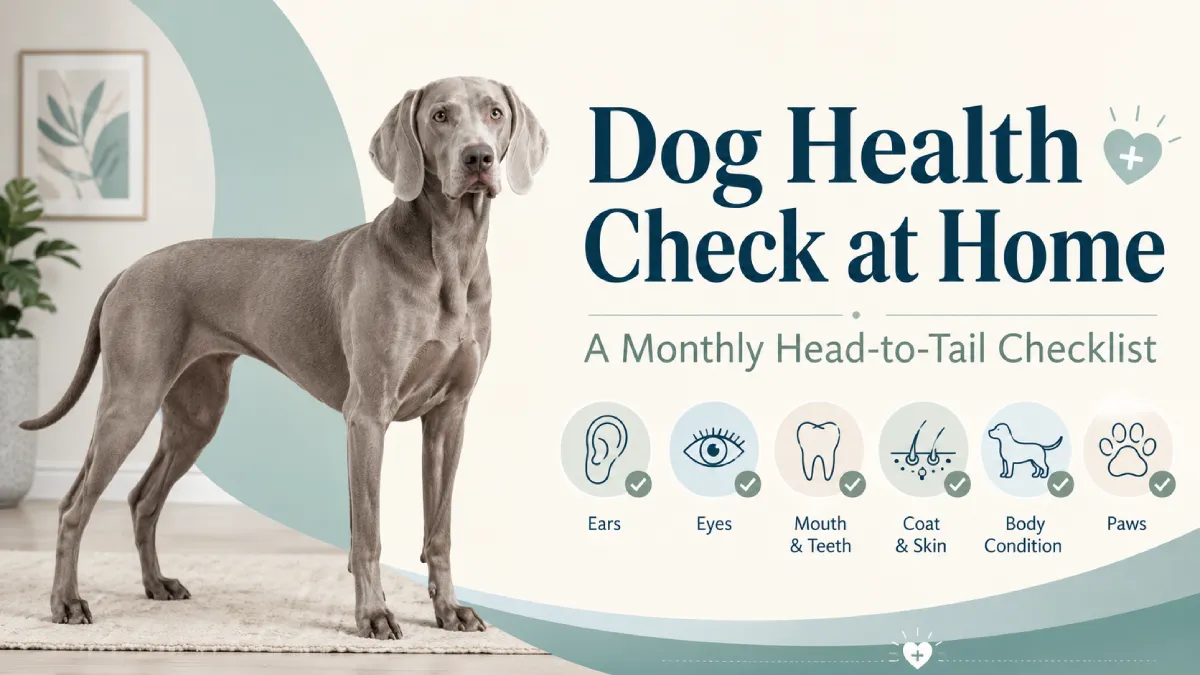
Dog Health Check at Home: A Monthly Head-to-Tail Checklist
A dog health check at home can help you notice changes in your dog’s appearance, behaviour, appetite, mobility and daily habits between veterinary visits. Once a month, take a few minutes to look at your dog’s eyes, ears, mouth, skin, coat, paws and overall body while also reviewing drinking, urination, stool, sleep and activity.
The goal is not to diagnose illness. It is to learn what is normal for your individual dog and notice when that baseline changes. Veterinary preventive-care guidance includes regular assessment of weight, body and muscle condition, skin, eyes, ears, mouth, mobility and other body systems. Home observations can add useful context, but they should never replace professional wellness examinations.
Quick Answer
A monthly dog health check should include behaviour, appetite, water intake, weight, body and muscle condition, eyes, ears, mouth, teeth, gums, breath, skin, coat, lumps, paws, nails, gait, breathing, urination and stool. Record changes rather than trying to identify the cause yourself. Persistent, painful or worsening changes need veterinary assessment, while breathing difficulty, collapse and other severe signs require urgent care.
What an At-Home Check Can and Cannot Do
An at-home check is most valuable for recognising change over time.
It can help you notice:
- gradual weight loss or gain
- a new lump
- worsening mobility
- changes in drinking or appetite
- new skin or coat problems
- changes in stool or urination
- unusual eye or ear findings
- altered breathing
- behavioural changes
Veterinary life-stage guidance specifically encourages owners to report observations about mobility, activity, behaviour and other changes noticed at home.
However, a home check cannot reliably:
- diagnose an infection
- identify a skin mass
- diagnose cancer
- determine why an eye is red
- diagnose heart disease from breathing or coughing alone
- stage dental disease
- diagnose dehydration from one physical sign
- replace laboratory testing or diagnostic imaging
A normal-looking checklist is also not a reason to skip veterinary wellness visits. Preventive examinations can reveal changes that are difficult or impossible to detect at home.
General Behaviour
Start the monthly check before touching your dog.
Watch normal behaviour for a few minutes.
Ask whether your dog:
- greets you normally
- responds to familiar people
- shows normal interest in food
- wants usual walks or play
- seems unusually withdrawn
- has become irritable
- appears confused
- avoids being touched
Changes in behaviour can accompany pain, disease, anxiety or cognitive changes and are worth discussing with your veterinarian when they persist or are substantial. Behaviour is included as an important health factor across canine life stages.
Record what changed and when rather than deciding whether the cause is behavioural or medical.
Appetite
Think about your dog’s usual pattern rather than whether one meal was completely finished.
Record changes such as:
- eating less
- eating unusually slowly
- leaving part of meals
- refusing familiar food
- unusual hunger
- chewing only on one side
- dropping food
- approaching food but walking away
Changes in appetite can occur with dental pain, gastrointestinal problems and many systemic illnesses. Nutritional assessment therefore considers food intake together with weight, body condition and other health factors.
A meaningful appetite change should be recorded even if your dog is still eating something.
Water Intake
Know your dog’s usual drinking pattern.
Watch for:
- drinking noticeably more
- drinking considerably less
- repeatedly emptying the bowl
- visiting the bowl without drinking
- a change that occurs alongside increased urination
If possible, measure water over a day when you suspect a genuine change rather than relying on memory.
Reduced drinking becomes more concerning when it occurs with vomiting, diarrhoea, weakness or illness.
Use Pawnium’s Signs of Dehydration in Dogs guide when hydration becomes the main concern.
Do not restrict water because you believe your dog is drinking too much. Increased drinking and urination should be investigated rather than controlled by limiting access to water.
Weight
Weigh your dog regularly when practical.
For a small dog, a household scale may work. Larger dogs may be easier to weigh during veterinary visits.
What matters most is the trend.
Record:
- current weight
- previous weight
- whether the change was intentional
- appetite during that time
- activity changes
AAHA recommends ongoing weight and nutritional assessment throughout a dog’s life because unexplained changes can indicate that feeding, activity or health needs further evaluation.
A steadily changing weight deserves more attention than a small one-off fluctuation.
Body Condition
Weight does not tell you how much body fat a dog carries.
Veterinary teams use a body condition score, or BCS, alongside body weight. The assessment includes the dog’s overall shape and the amount of fat covering areas such as the ribs.
Ask your veterinarian to show you your dog’s ideal body condition so you have a personalised baseline.
At home, monitor whether:
- ribs become harder or easier to feel
- the waist becomes less visible
- the abdomen changes shape
- overall body condition changes noticeably
Do not press hard into the ribs or abdomen.
Muscle Condition
Muscle condition is different from body condition.
A dog can carry excess body fat while still losing muscle.
Veterinary muscle-condition assessment pays particular attention to areas including the:
- spine
- shoulder blades
- skull
- pelvis
AAHA recommends assessing muscle condition separately from body condition throughout life, with particular importance in ageing dogs.
At home, watch for increasing boniness or visible loss of muscle rather than performing aggressive palpation.
Eyes
Compare both eyes in good lighting.
Look for:
- redness
- discharge
- cloudiness
- swelling
- excessive tearing
- frequent blinking
- squinting
- rubbing
- pupil differences
- apparent difficulty seeing
The appearance of discharge or redness alone cannot identify the cause.
Some eye problems can become urgent. Cornell notes that glaucoma, for example, may initially cause redness and squinting and can threaten vision without prompt treatment.
Use Pawnium’s Dog Eye-Discharge Guide for detailed troubleshooting when discharge becomes the main concern.
Contact Your Veterinarian Promptly for Eye Pain
Do not wait for the next monthly check if your dog develops:
- persistent squinting
- obvious eye pain
- sudden cloudiness
- significant swelling
- eye trauma
- sudden apparent vision loss
Eye problems can worsen quickly and may need time-sensitive treatment.
Ears
Look only at the outer ear flap and visible entrance to the canal.
Record:
- redness
- swelling
- discharge
- unusual wax
- odour
- crusting
- head shaking
- scratching
- pain when the ear is touched
Otitis externa can cause redness, swelling, discharge, odour, itching and pain, but the underlying cause may involve infection, allergy, parasites or foreign material.
Use Pawnium’s Dog Ear-Infection Signs article if ear symptoms are present.
Do Not Examine Deep Inside the Ear
Do not:
- push cotton swabs down the ear canal
- probe the ear with tools
- attempt to remove deeply lodged material
- aggressively clean a painful ear
If your dog pulls away or cries when the ear is touched, stop and arrange veterinary assessment.
Nose
Do not judge health simply by whether your dog’s nose feels wet or dry.
Instead, look for changes such as:
- persistent discharge
- bleeding
- new crusting
- ulcers
- swelling
- obvious pain
- significant colour change
A nose may naturally vary in moisture during the day.
The useful information is a persistent or new abnormality compared with your dog’s normal appearance.
Mouth
Only inspect the mouth if your dog is comfortable with handling.
Lift the lips gently rather than forcing the jaws open.
Look for:
- swelling
- obvious growths
- excessive saliva
- blood
- clearly visible foreign material
- changes in the way the mouth opens or closes
Do not reach toward the throat or pull on deeply embedded objects.
Do Not Force the Mouth Open
Pain can cause even a normally tolerant dog to resist.
If your dog suddenly refuses mouth handling, that behaviour itself is worth recording and discussing with your veterinarian.
Teeth
Look at the visible teeth for:
- yellow or brown tartar
- fractures
- unexpected missing teeth
- loose-looking adult teeth
- unusual tooth colour
An owner can only see part of each tooth.
Veterinary dental assessment can identify disease beneath the gumline that cannot be evaluated during a simple home inspection.
Do not scrape tartar yourself or manipulate a painful tooth.
Gums
Learn your dog’s normal gum appearance.
Normal pigmentation varies considerably between dogs, so comparisons with your own dog’s baseline are more useful than comparing with online photographs.
Look for:
- new redness
- swelling
- bleeding
- obvious gum recession
- major colour change
Red or swollen gums, bleeding and bad breath are recognised dental-disease warning signs.
Abnormal Gum Colour Can Be Urgent
Pale, white, grey, blue or purple gums—particularly with weakness, breathing difficulty or collapse—require prompt veterinary attention. AAHA lists abnormal gum colour alongside respiratory or circulatory problems as an emergency warning sign.
Breath
Persistent bad breath should not automatically be dismissed as normal.
AAHA identifies halitosis as one of the early signs owners may notice with dental disease.
Bad breath becomes more important when combined with:
- red gums
- visible tartar
- drooling
- difficulty eating
- dropping food
- bleeding
- facial swelling
Use Pawnium’s Dog Bad-Breath Guide for detailed dental-health troubleshooting.
Skin
Part the coat in several locations.
Good areas to inspect include:
- back
- belly
- armpits
- groin
- neck
- tail base
- legs
Look for:
- redness
- scales or flakes
- crusts
- unusual oiliness
- wounds
- odour
- irritation
- scratching or licking
Dermatitis may cause combinations of itching, scaling, redness, pigmentation, odour, oiliness and hair loss, but those findings are not specific to one disease.
Use Pawnium’s Dog Itching Guide or Dog Dry-Skin Guide when those symptoms become the main concern.
Coat
Run your hands gently through the coat.
Record:
- new thinning
- bald patches
- excessive shedding
- broken hair
- matting
- greasy areas
- dullness
- dandruff
Hair loss is a sign rather than a diagnosis. Infections, parasites, inflammation, hormonal disorders and other problems may all affect the hair or follicles.
Use Pawnium’s Dog Hair-Loss Guide when true thinning or bald spots are present.
Lumps and Bumps
Run your hands gently over your dog’s body.
Do not squeeze tissue deeply.
If you find a lump, record:
- location
- date discovered
- length
- width
- surface appearance
- whether it appears to be changing
- whether touching it causes pain
Do not decide that a lump is harmless because it is soft, small or movable.
AAHA’s 2026 oncology guidelines state that the nature and behaviour of a mass cannot be determined from palpation or imaging alone; sampling may be needed for identification.
Use Pawnium’s Dog Lumps and Bumps Guide for the dedicated monitoring tracker and sampling explanation.
Paws
Check all four paws.
Look at:
- pads
- tops of the feet
- visible skin between toes
- nails
- dewclaws
Record:
- redness
- cuts
- cracks
- swelling
- persistent licking
- discharge
- visible loose debris
- odour
Do not dig into the pad or probe deeply between painful toes.
Use Pawnium’s Dog Paw-Licking Guide when repeated licking or chewing is the main issue.
Nails
Look for:
- excessive length
- splitting
- cracks
- bleeding
- broken nails
- damaged dewclaws
Notice whether long nails are changing how your dog stands or walks.
Do not pull off a partially attached nail.
If a nail is painful, bleeding significantly or damaged near the base, veterinary assessment may be needed.
Legs and Gait
Observe your dog moving naturally.
Useful movements include:
- walking toward you
- walking away
- turning
- standing from lying down
- climbing a familiar step if normally able
Look for:
- limping
- stiffness
- shortened stride
- reluctance to bear weight
- difficulty rising
- slipping
- reluctance to jump
- reduced willingness to exercise
AAHA specifically recommends collecting owner observations of mobility and activity because changes at home can help identify developing orthopaedic disease.
Use Pawnium’s Dog Limping Article for more detailed gait troubleshooting.
Do Not Manipulate a Painful Limb
Do not:
- force a joint through its range of motion
- repeatedly press a painful area
- straighten an obviously injured limb
- manipulate a suspected fracture
Record what you observe and seek veterinary assessment.
Belly
A home dog body check should involve looking, not attempting a deep abdominal examination.
Notice:
- new enlargement
- obvious asymmetry
- bloating
- visible discomfort
- guarding
- repeated looking toward the abdomen
- unusual posture
Do not press deeply trying to feel internal organs.
Sudden Abdominal Enlargement Can Be an Emergency
A rapidly enlarged or painful abdomen combined with repeated unsuccessful attempts to vomit, drooling, restlessness, pale gums, weakness or collapse can occur with gastric dilatation-volvulus and requires immediate veterinary care.
Breathing
Observe breathing while your dog is resting calmly.
Do not judge breathing immediately after:
- exercise
- excitement
- heat exposure
Watch:
- chest movement
- abdominal movement
- respiratory noise
- whether the mouth is open
- whether the dog can settle comfortably
Record new:
- coughing
- noisy breathing
- increased abdominal effort
- exercise intolerance
- repeated night-time respiratory changes
Use Pawnium’s Dog Coughing and Gagging Guide when cough is the main problem.
Breathing Difficulty Is an Emergency
Seek urgent veterinary care if breathing appears difficult.
Warning signs may include:
- gasping
- marked abdominal effort
- persistent noisy breathing
- blue, grey or purple gums
- collapse
- severe weakness
AAHA treats respiratory distress as an emergency because serious heart, lung, airway and other conditions can cause it.
Urination
Watch your dog’s normal toilet habits.
Record:
- frequency
- unusually large volumes
- unusually small amounts
- accidents
- straining
- obvious discomfort
- blood
- simultaneous changes in drinking
Do not diagnose diabetes, kidney disease or urinary infection from one change.
Repeated attempts to urinate with little or no urine require prompt veterinary assessment because urinary obstruction can become dangerous.
Stool
Look at:
- consistency
- frequency
- unusual urgency
- straining
- mucus
- blood
- black or tarry appearance
A single unusual stool in a dog otherwise acting normally may be less concerning than repeated diarrhoea accompanied by vomiting, weakness or appetite loss.
Use Pawnium’s Dog Poop Colour Chart when colour is the main question.
If vomiting is occurring as well, link naturally to the Dog Vomit Colour Chart.
Persistent vomiting or diarrhoea can cause dehydration and weakness and may require veterinary care, particularly in puppies, seniors or dogs that appear unwell.
Sleep
Know your dog’s normal sleep pattern.
Record new:
- night waking
- pacing
- difficulty settling
- increased daytime sleeping
- sudden change in sleeping location
- apparent discomfort when lying down
Sleep change does not identify one disease.
Pain, urinary problems, respiratory disease and behavioural or cognitive changes may all affect sleep.
In older dogs, altered sleep-wake cycles can occur as part of canine cognitive dysfunction alongside disorientation, altered social interaction, house-soiling, activity changes and anxiety.
Activity Level
Compare your dog with its own normal activity level.
Ask whether it:
- still wants normal walks
- tires earlier
- plays for less time
- hesitates on stairs
- avoids jumping
- needs longer recovery after exercise
AAHA encourages owners to discuss activity and mobility changes during preventive veterinary care because these observations can reveal developing health problems.
Behaviour Changes
Keep a record of new:
- irritability
- withdrawal
- clinginess
- anxiety
- house soiling
- restlessness
- confusion
- vocalisation
- resistance to touch
A behaviour change may occur because of pain, illness, stress or neurological change.
Do not label a suddenly irritable dog as “badly behaved” without considering discomfort or disease.
In senior dogs, changes involving disorientation, interaction, sleep, house training, activity and anxiety are particularly important to report.
Senior-Dog Additions
Older dogs benefit from closer trend monitoring.
Add these items to the monthly checklist:
- ease of rising
- stair use
- slipping
- muscle condition
- unintended weight change
- night waking
- house-soiling changes
- confusion
- vision changes
- hearing changes
- new lumps
- chronic wounds
- medication tolerance
Ageing dogs may lose muscle or develop mobility, dental, cognitive and other chronic health problems. AAHA senior-care guidance emphasises monitoring body and muscle condition, behaviour and age-related changes rather than attributing them automatically to “getting old.”
Use Pawnium’s Senior-Dog Care Guide for the broader life-stage discussion.
Senior home monitoring also does not replace veterinary care. AAHA recommends more frequent examinations in the senior stage, commonly at least every six months.
Puppy Additions
Puppies grow and change rapidly.
Add:
- body-weight trend
- growth
- body condition
- appetite
- stool
- behaviour
- chewing and tooth changes
- mobility
- vaccination schedule
- parasite prevention
- any congenital condition already being monitored
Puppies need frequent veterinary examinations because nutritional, vaccination, behavioural and developmental needs change quickly during this stage.
Do not postpone scheduled puppy visits because everything looks normal on the monthly checklist.
What to Photograph
Photographs and videos can make gradual changes easier to compare.
Useful things to record include:
- lumps
- areas of hair loss
- skin redness
- wounds
- eye discharge
- paw swelling
- unusual stool or vomit
- posture changes
Short videos can be particularly useful for:
- limping
- coughing
- unusual breathing
- repetitive behaviours
- difficulties getting up
Use approximately the same angle and lighting when monitoring the same visible lesion.
Do not deliberately provoke a symptom to obtain a photograph or video.
What to Record
A useful monthly record should include:
- Date
- Weight
- Appetite
- Water intake
- Body-condition trend
- Muscle-condition trend
- Eye findings
- Ear findings
- Mouth and dental findings
- Skin and coat
- Lumps
- Paws and nails
- Mobility
- Breathing
- Stool
- Urination
- Sleep
- Activity
- Behaviour
- Current medications
- Photos or videos
- Veterinary follow-up
Recording a baseline makes small changes easier to recognise than trying to remember what your dog looked or behaved like several months earlier.
What Should Never Be Checked Aggressively at Home
A monthly dog health check should be gentle.
Stop if your dog becomes painful, fearful or strongly resistant.
Do not:
- force the mouth open
- probe painful teeth
- examine deep inside the ears
- push cotton swabs down the ear canal
- deeply palpate the abdomen
- squeeze or puncture lumps
- dig into paw pads
- aggressively flex painful joints
- pull on broken nails
- manipulate suspected fractures
- repeatedly test a painful body part
- provoke coughing or limping for a video
The purpose is to record changes rather than trying to diagnose them.
A veterinary physical examination includes assessments that cannot safely or accurately be reproduced at home. AAHA’s life-stage guidance describes professional examinations that evaluate the heart, lungs, gastrointestinal and urinary systems, nervous system, joints and other structures in addition to visible external findings.
When to Book Routine Veterinary Care
Do not use home checks as a reason to skip veterinary wellness visits.
Professional examinations can assess:
- heart and lung sounds
- lymph nodes
- abdominal structures
- dental disease below the gumline
- joint and neurological function
- body and muscle condition
- diagnostic blood or urine findings
- vaccination needs
- parasite prevention
Preventive-care schedules depend on age, health, breed and individual risk. Mature adult dogs commonly receive wellness examinations once or twice each year, while puppies need more frequent visits and seniors often require closer monitoring.
Follow your veterinarian’s schedule if your dog needs more frequent care.
When to Seek Prompt Veterinary Care
Do not wait for the next monthly check when you notice persistent, worsening or painful changes.
Examples include:
- unexplained appetite change
- unexplained weight loss
- major drinking or urination changes
- repeated vomiting or diarrhoea
- persistent eye redness or squinting
- painful or discharging ears
- broken teeth
- red or bleeding gums
- persistent bad breath with dental changes
- significant itching
- new bald areas
- a new or changing lump
- painful paw problems
- persistent limping
- repeated coughing
- new breathing changes
- substantial lethargy
- major behaviour change
A new mass also deserves proper veterinary assessment rather than visual diagnosis. AAHA recommends microscopic sampling when necessary because masses cannot reliably be identified through touch or appearance alone.
Emergency Warning Signs
Seek urgent veterinary care for severe or rapidly developing signs such as:
- difficulty breathing
- blue, grey or purple gums
- very pale or white gums with weakness
- collapse
- seizures
- extreme weakness
- major trauma
- uncontrolled bleeding
- inability to urinate
- severe eye trauma
- severe pain
- repeated persistent vomiting with marked illness
- severe bloody diarrhoea with weakness
- suddenly enlarged painful abdomen
- repeated unproductive retching with abdominal swelling
- suspected poisoning
AAHA identifies respiratory difficulty, persistent severe gastrointestinal illness, abnormal gum colour, eye injury and extreme weakness among potential emergencies. GDV is another life-threatening condition that may cause abdominal distension, repeated unsuccessful retching, restlessness, pale gums, weakness or collapse.
When a true emergency sign is present, do not finish the rest of the checklist before seeking help.
Printable Monthly Dog Health Checklist
Use one sheet each month and compare it with previous months.
| Check | This Month | Change From Normal? | Notes / Follow-Up |
|---|---|---|---|
| Weight | ______ | Yes / No | ______ |
| Appetite | Normal / Increased / Reduced | Yes / No | ______ |
| Water | Normal / Increased / Reduced | Yes / No | ______ |
| Eyes | Normal / Change noted | Yes / No | ______ |
| Ears | Normal / Change noted | Yes / No | ______ |
| Teeth | Normal / Change noted | Yes / No | ______ |
| Gums | Normal / Change noted | Yes / No | ______ |
| Breath | Usual / Changed | Yes / No | ______ |
| Skin | Normal / Change noted | Yes / No | ______ |
| Coat | Normal / Change noted | Yes / No | ______ |
| Lumps | None new / New / Changed | Yes / No | Lump #_____ |
| Paws | Normal / Change noted | Yes / No | ______ |
| Nails | Normal / Change noted | Yes / No | ______ |
| Mobility | Normal / Changed | Yes / No | ______ |
| Stool | Normal / Changed | Yes / No | ______ |
| Urination | Normal / Changed | Yes / No | ______ |
| Breathing | Normal / Changed | Yes / No | ______ |
| Behaviour | Normal / Changed | Yes / No | ______ |
| Medication | ______ | Changed? Yes / No | ______ |
| Veterinary follow-up | None / Booked / Needed | — | Date: ______ |
Monthly Notes
Date: __________________
Weight: __________________
Body condition compared with last month:
Same / Leaner / Heavier / Unsure
Muscle condition compared with last month:
Same / Possible loss / Unsure
Activity:
Normal / Reduced / Increased
Sleep:
Normal / Changed
Photos or videos taken:
Yes / No
Most important change this month:
Questions for veterinarian:
How to Use the Checklist
The most useful question is:
“What has changed from my dog’s normal?”
The checklist should not be used to answer:
“What disease does my dog have?”
If you identify a change, record it and move to the relevant Pawnium symptom guide or contact your veterinarian.
FAQs
How often should I do a dog health check at home?
Once a month is a practical schedule for consistent monitoring. The purpose is to establish a baseline and spot gradual changes in weight, appearance, mobility and daily habits. A monthly check does not replace scheduled veterinary examinations.
Can an at-home health check tell me whether my dog is healthy?
No. A dog may look normal while having dental, cardiac, metabolic or other problems that require professional examination or diagnostic testing. The checklist helps detect changes and collect useful information; it does not certify that a dog is medically healthy.
What is the most useful thing to record?
Changes from your dog’s own baseline are particularly helpful. Weight, appetite, drinking, urination, stool, mobility, breathing, behaviour and visible physical changes can all provide useful information for your veterinary team.
Should I check my dog’s gums?
If your dog comfortably allows lip handling, it is useful to learn what its normal visible gums look like. Record new redness, bleeding or major colour changes without aggressively pressing the tissue. Pale, white, blue, grey or purple gums with illness can require urgent veterinary assessment.
What if my dog will not let me examine part of its body?
Do not force the examination. Resistance may reflect fear, handling sensitivity or pain. Record which area your dog protects and tell your veterinarian, especially if the reluctance is new.
Can my dog skip a wellness visit if every monthly check looks normal?
No. At-home monitoring cannot replace a professional veterinary examination, vaccination planning, dental evaluation, laboratory testing or other preventive care. Continue wellness visits according to your veterinarian’s recommended schedule.


