
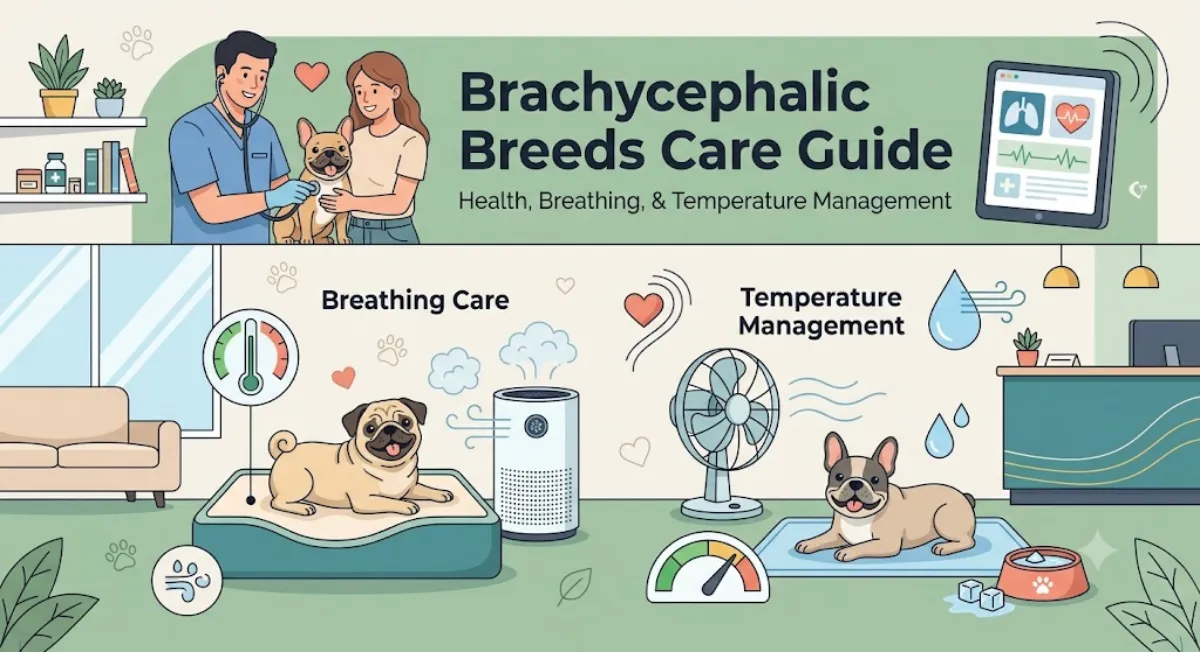
Brachycephalic Dog Care: Breathing, Heat, Exercise and Daily Safety
Good brachycephalic dog care starts with understanding that a flattened face affects more than appearance. Shortened skull anatomy can influence breathing, cooling, sleep, eating, eyes, teeth and skin folds, although severity differs considerably between individual dogs. Noisy breathing or poor exercise tolerance should therefore not be dismissed simply because a French Bulldog, Pug, Bulldog or Boston Terrier belongs to a short-faced breed.
Daily management focuses on keeping the dog lean, exercising within comfortable limits, avoiding dangerous heat exposure, reducing pressure on the neck and monitoring for changes that deserve veterinary assessment.
Quick Answer
Brachycephalic dogs need individual care based on their actual breathing, facial structure, weight and health. Use steady exercise in suitable weather, walk on a well-fitted harness, maintain healthy body condition, monitor eyes and skin folds, and pay attention to sleep and feeding difficulties. Laboured breathing, blue or grey gums or tongue, collapse, or severe heat illness require urgent veterinary care.
What Does Brachycephalic Mean?
Brachycephalic means “short-headed.”
In dogs, the term refers to skull conformation in which the muzzle and facial bones are shortened relative to dogs with more typical head proportions. Common examples include:
- French Bulldogs
- Pugs
- English Bulldogs
- Boston Terriers
- Pekingese
Other breeds can also have brachycephalic conformation to varying degrees.
Brachycephaly itself describes anatomy. It does not tell you exactly how impaired an individual dog’s breathing will be.
Why Facial Anatomy Can Affect Breathing
Shortening the skull does not necessarily reduce all of the soft tissues of the mouth and throat proportionally.
This can leave airway structures crowded into a smaller space. Abnormalities associated with brachycephalic obstructive airway syndrome, or BOAS, can include:
- narrowed nostrils, or stenotic nares
- an elongated or thickened soft palate
- excessive tissue in the throat
- everted laryngeal saccules
- laryngeal collapse
- narrowed trachea in some dogs
These changes can increase resistance to airflow and make breathing physically harder.
BOAS is therefore more than “a dog with a short nose.” It refers to clinically meaningful airway obstruction associated with brachycephalic anatomy.
Breathing Noise
A key point for owners is that common does not equal healthy.
The University of Cambridge BOAS programme states that a normal upper airway breathes quietly. Snoring, snorting and other respiratory noises can indicate obstruction somewhere in the nasal cavity, throat or larynx.
Monitor whether your dog’s breathing is:
- becoming louder over time
- noisy while awake and resting
- noisy after very light activity
- accompanied by increased chest or abdominal effort
- associated with open-mouth breathing after minimal exertion
One sound cannot tell you exactly which airway structure is involved, so recordings can help your veterinarian understand what happens at home.
Exercise Tolerance
Short-faced dogs still need physical activity.
The goal is not to keep them inactive. Regular exercise helps maintain fitness and healthy body condition. The problem arises when activity repeatedly produces excessive respiratory effort, overheating or prolonged recovery. The RSPCA recommends regular, steady exercise rather than strenuous exertion for dogs affected by brachycephalic breathing limitations.
Watch for a dog that:
- stops much earlier than expected
- sits or lies down during mild activity
- becomes extremely noisy
- cannot keep pace with an ordinary walk
- needs unusually long to settle afterward
- becomes distressed rather than simply tired
Do not use another dog of the same breed as the standard for what yours should tolerate.
Heat Sensitivity
Panting is one of the main ways dogs dissipate heat.
In dogs with obstructed nasal and upper-airway anatomy, that cooling process can be less effective. Brachycephalic dogs are therefore at increased risk of heat-related illness.
Heat risk depends on more than the temperature displayed on a weather app.
Consider:
- humidity
- direct sunlight
- exercise intensity
- airway function
- body condition
- age
- fitness
- access to shade and water
There is no single outdoor temperature guaranteed to be safe for every flat-faced dog.
Weight Management
Excess body fat can make airway problems worse.
ACVS specifically notes that obesity aggravates brachycephalic airway syndrome, while general AAHA weight-management guidance also links excess weight with respiratory and other health problems.
Monitor:
- body weight
- rib coverage
- visible waist
- body condition score
- changes in activity
- treats and extras
If weight loss is needed, use a measured veterinary-supported plan rather than simply cutting food drastically. AAHA recommends individualized calorie adjustment based on the dog’s ideal condition and response.
Walking Conditions
Schedule walks around the dog’s respiratory comfort rather than a fixed daily distance.
During warm weather:
- choose cooler times of day
- favour shade
- reduce intensity
- shorten the outing if breathing becomes more difficult
- provide access to water
- stop rather than pushing the dog to complete a route
Flat-faced dogs can develop heat-related illness during exercise, not only inside parked cars.
A dog that copes comfortably on a cool morning may struggle with the same route when conditions become warmer or more humid.
Harnesses and Collars
For leash walking, a well-fitted harness is generally preferable to applying leash pressure around the neck of a brachycephalic dog.
The RSPCA recommends harness use in flat-faced dogs to avoid additional pressure around the neck and airway.
A suitable harness should:
- fit securely
- avoid rubbing the armpits
- allow natural shoulder movement
- give the handler adequate control
- not tighten around the throat
A harness is a handling aid. It does not correct an obstructed airway.
Car Travel
Keep vehicle travel cool, controlled and low-stress.
Before setting off:
- cool the car if conditions are warm
- use effective ventilation or air conditioning
- secure the dog safely
- carry water
- watch respiratory effort during breaks
Never leave a dog unattended in a warm parked vehicle. The RSPCA notes that vehicles can become dangerously hot even when outside conditions do not seem extreme.
Because flat-faced dogs already have increased heat vulnerability, delays in a hot stationary vehicle deserve particular caution.
Air Travel Considerations
Air travel requires additional planning for short-nosed dogs.
USDA guidance updated in 2026 specifically states that brachycephalic dogs require extra care during air travel because stress and extreme temperatures increase the risk of breathing difficulty and heatstroke.
Airline rules also change. The U.S. Department of Transportation notes that many carriers impose restrictions on brachycephalic pets because of respiratory risk, while IATA advises passengers to verify current airline-specific requirements before travel.
Before booking:
- Ask your veterinarian whether the individual dog is suitable to fly.
- Check the airline’s current brachycephalic-pet policy.
- Confirm cabin versus cargo rules.
- Check temperature and seasonal restrictions.
- Confirm carrier requirements.
- Recheck requirements shortly before departure.
Do not assume that because a dog has flown previously, the same airline will accept it under current rules.
Sleeping
Sleep can reveal airway problems that daytime activity does not.
Cambridge describes sleep-disordered breathing and obstructive sleep apnoea among the problems seen in BOAS-affected dogs.
Discuss signs such as:
- very loud snoring
- repeated waking
- obvious struggling for breath
- pauses in breathing
- sleeping sitting upright
- persistently raising the head to sleep
- inability to settle comfortably
Snoring should not automatically be classified as harmless simply because the breed is known for it.
Feeding
Brachycephalic airway problems can sometimes interfere with eating and swallowing.
Affected dogs may gag, retch, cough or have difficulty coordinating swallowing because crowded soft tissues can obstruct the region around the airway and oesophagus.
Record if your dog repeatedly:
- coughs during meals
- gags
- spits food out
- struggles to swallow
- becomes breathless while eating
Do not assume a new bowl, feeding position or food texture will solve the underlying problem without knowing its cause.
Regurgitation
Regurgitation can occur alongside BOAS.
Cambridge describes associations between BOAS and gastrointestinal abnormalities including gastro-oesophageal reflux, oesophageal problems and hiatal hernia. The negative pressure generated while a dog struggles to breathe may contribute to gastrointestinal dysfunction.
Repeated regurgitation should be discussed with a veterinarian, particularly if it occurs with:
- gagging
- coughing
- weight loss
- eating difficulty
- respiratory signs
Do not dismiss it as a standard flat-faced-dog habit.
Dental Crowding
A shortened jaw can affect how the normal number of teeth fit into the mouth.
AAHA notes that brachycephalic breeds have increased dental problems because teeth may be rotated or crowded.
Routine oral care should include:
- veterinary dental assessment
- home tooth brushing where tolerated
- monitoring for bad breath
- checking for red or bleeding gums
- watching for difficulty eating
- investigating retained or poorly positioned teeth
The visible front teeth tell only part of the story. Comprehensive veterinary dental assessment may require dental radiographs to evaluate structures below the gumline.
Eye Exposure and Injury
Many flat-faced dogs have relatively shallow eye sockets and prominent eyes.
This can leave the corneal surface more exposed to trauma, drying and ulceration. RVC ophthalmology guidance identifies brachycephalic breeds as being particularly susceptible to corneal disorders.
Contact a veterinarian promptly if you notice:
- squinting
- holding an eye closed
- marked redness
- cloudiness
- sudden excessive tearing
- eye discharge
- rubbing at the eye
- obvious injury
Eye pain should not be monitored casually for several days in a dog whose eyes are highly exposed.
Skin Folds
Facial folds can trap moisture, debris and microorganisms.
RVC dermatology guidance explains that deep folds create conditions that favour recurrent irritation and infection, particularly in breeds with more pronounced facial folds.
If your dog has folds:
- inspect them regularly
- keep them clean and dry
- watch for redness
- notice odour
- check for discharge or moisture
- seek veterinary advice for persistent soreness
Not every short-faced dog has the same depth or number of folds, so the care routine should match the individual anatomy.
Grooming
There is no single brachycephalic grooming routine because these breeds have different coats.
A French Bulldog’s coat needs differ from a Shih Tzu’s, for example.
Across the group, grooming provides a useful opportunity to check:
- skin folds
- ears
- eyes
- nails
- paws
- body condition
- new lumps or skin irritation
For dogs with deep facial or tail folds, fold care may need to be incorporated into the regular routine.
Avoid using strongly fragranced or irritating products around the eyes and folds without veterinary guidance.
French Bulldogs
French Bulldogs are one of the breeds most strongly associated with current BOAS research and clinical respiratory grading.
Individuals vary significantly. Some have relatively functional breathing, while others show marked nostril narrowing, respiratory noise, heat intolerance, gastrointestinal signs or poor exercise tolerance. Cambridge’s functional grading programme specifically includes French Bulldogs.
This pillar should cover the general principles only.
The dedicated French Bulldog breathing-care article should own:
- French Bulldog exercise decisions
- breed-specific heat management
- French Bulldog panting
- recovery after exercise
- ownership monitoring
Pugs
Pugs are also a core brachycephalic breed in BOAS research.
Their combination of shortened facial anatomy, prominent eyes and skin folds means breathing should not be the only part of health monitoring. Respiratory function, heat tolerance, eyes, weight and folds all matter.
Cambridge’s respiratory functional-grading resources include a specific protocol for Pugs.
Again, not every Pug is affected to the same severity.
Bulldogs
English Bulldogs can experience several consequences associated with extreme brachycephalic conformation, including respiratory, skin and eye problems. RVC research and clinical resources identify Bulldogs among the breeds commonly presenting with these issues.
Cambridge’s functional BOAS grading resources also include Bulldogs.
For an individual Bulldog, monitor function rather than assuming severe noise, poor exercise tolerance or heat intolerance is unavoidable.
Boston Terriers
Boston Terriers are brachycephalic dogs even though their overall body build differs substantially from a Bulldog or Pug.
ACVS specifically lists Boston Terriers among the breeds affected by brachycephalic airway syndrome. USDA also includes them among short-nosed breeds needing additional caution during air travel.
A Boston Terrier that is athletic and active can still have clinically important airway obstruction, so high enthusiasm should not be used as proof that breathing is normal.
Other Short-Faced Breeds
Brachycephalic conformation is not limited to four popular breeds.
RVC and veterinary sources also identify breeds such as:
- Pekingese
- Shih Tzu
- Boxer
- Cavalier King Charles Spaniel
among dogs with shortened facial anatomy to varying degrees.
The same principles apply:
look at the individual dog’s anatomy and function rather than assuming every breed—or every dog within a breed—has identical risk.
Individual Differences Matter
Two dogs of the same brachycephalic breed can breathe very differently.
Cambridge’s BOAS functional grading system recognizes dogs ranging from clinically unaffected to moderately or severely affected.
Differences can involve:
- nostril openness
- soft-tissue anatomy
- tongue and palate structure
- body weight
- age
- activity
- degree of facial shortening
- secondary airway changes
This is why neither extreme statement is useful:
“Every flat-faced dog is severely affected.”
or:
“My dog’s breed always breathes this way, so it must be fine.”
Assessment should be individual.
What Should Not Be Dismissed as “Normal for the Breed”
Several signs are sometimes normalized because they occur frequently in brachycephalic dogs.
Do not automatically dismiss:
- persistent respiratory noise while awake
- struggling after light exercise
- prolonged inability to settle after activity
- frequent sleep disruption
- repeated gagging or regurgitation
- breathing difficulty during eating
- inability to tolerate mild warmth
- repeated eye injuries
- chronically sore skin folds
- collapse
Cambridge states that normal upper-airway breathing should be quiet, and RVC has repeatedly warned that breathing difficulty and other consequences of extreme conformation can become incorrectly normalized by owners.
Common is not the same as healthy.
Veterinary Airway Assessment
A veterinarian can assess whether respiratory signs warrant further investigation.
Initial assessment may include:
- history
- nostril examination
- body condition
- resting respiratory observation
- exercise tolerance
- breathing sounds
- sleep history
- gastrointestinal signs
Cambridge uses a standardized functional BOAS grading approach in selected breeds. More detailed evaluation may include imaging, laryngoscopy or endoscopy, depending on the dog and clinical findings.
Do not attempt to reproduce a formal exercise stress test at home.
If everyday activity already produces significant respiratory distress, that is information for the veterinarian—not a reason to deliberately push the dog harder to measure its limit.
Signs of Respiratory Distress
Seek prompt veterinary advice when breathing changes substantially.
More concerning signs include:
- obvious abdominal or chest effort
- inability to settle
- persistent open-mouth breathing unrelated to ordinary panting
- head or neck extension to breathe
- worsening airway noise
- severe exercise intolerance
- weakness
Blue, grey or purple gums or tongue, severe respiratory distress, unconsciousness or collapse are emergencies.
Do not wait for the dog to “sleep it off” when oxygenation appears compromised.
Heat Emergency Warning Signs
Heat illness can progress rapidly.
Warning signs include:
- very heavy panting
- difficulty breathing
- excessive drooling
- weakness
- lethargy
- confusion
- poor coordination
- vomiting or diarrhoea
- collapse
- seizures in severe cases
If overheating is suspected:
- Stop further exercise and heat exposure.
- Move the dog into shade or a cooler environment.
- Begin active cooling with water cooler than the dog’s body temperature while arranging veterinary help.
- Seek veterinary assessment urgently.
Current RSPCA guidance emphasizes cool first, transport second rather than waiting until arrival at the clinic before beginning cooling.
Because respiratory compromise and overheating can reinforce one another in brachycephalic dogs, deterioration should be taken seriously.
Daily-Care Checklist
Use a short daily check rather than waiting until a problem becomes dramatic.
Before Activity
Check:
- current weather
- humidity and sun exposure
- resting breathing
- energy level
- whether the dog has eaten recently
- whether conditions are suitable for the planned activity
During Activity
Watch:
- respiratory noise
- breathing effort
- slowing or stopping
- tongue and gum appearance
- coordination
- heat exposure
After Activity
Record:
- whether breathing returned to its usual baseline
- whether recovery seems slower than normal
- whether gagging or regurgitation occurs
- whether the dog can settle comfortably
There is no universal evidence-based rule such as “every brachycephalic dog must recover within five minutes.” Use your dog’s established baseline and seek veterinary advice when recovery becomes clearly slower or more difficult.
At Home
Regularly check:
- body weight and condition
- eyes
- skin folds
- teeth
- sleep
- feeding comfort
- regurgitation
- general behaviour
The more useful question is not:
“Is this common in flat-faced dogs?”
It is:
“Is my dog functioning comfortably, and has anything changed?”
FAQs
Do all brachycephalic dogs have BOAS?
No. Brachycephalic anatomy increases risk, but respiratory function varies. Cambridge’s functional grading system includes clinically unaffected as well as affected dogs. A veterinarian can assess the individual dog’s breathing rather than diagnosing BOAS from breed alone.
Is snoring normal in a flat-faced dog?
Snoring is common but should not automatically be called healthy. Cambridge identifies snoring and snorting as respiratory noises associated with upper-airway obstruction. Loud, worsening snoring or sleep disturbance deserves veterinary discussion.
How much exercise should a brachycephalic dog get?
There is no single duration suitable for all dogs. Regular steady exercise is important, but the amount should be adjusted for airway function, fitness, body condition, age and environmental conditions. Avoid repeatedly exercising the dog into respiratory distress.
Should brachycephalic dogs wear a harness?
For leash walking, a well-fitted harness is generally preferred because it avoids concentrating leash pressure on the neck and airway. It does not treat BOAS.
Can brachycephalic dogs fly safely?
Air travel can carry additional breathing and heat risks for short-nosed dogs. USDA recommends extra care, and airline policies differ; many carriers restrict brachycephalic pets. Discuss your dog’s individual fitness to fly with a veterinarian and confirm current airline requirements before booking.
When is breathing an emergency?
Severe laboured breathing, blue/grey/purple gums or tongue, collapse, loss of consciousness or rapidly worsening distress require urgent veterinary care.