
What to Do If Your Cat Gets Lost: Immediate Search and Recovery Checklist
When a cat disappears, start searching rather than waiting to see whether they return on their own. Check the entire home first, then work outward from the last confirmed location while alerting neighbors, shelters, veterinary clinics and the microchip registry.
A frightened cat, especially an indoor-only cat suddenly outside, may hide quietly and may not respond to their name as they normally would at home. That makes a slow, physical search of nearby hiding places especially important.
Immediate Action Checklist
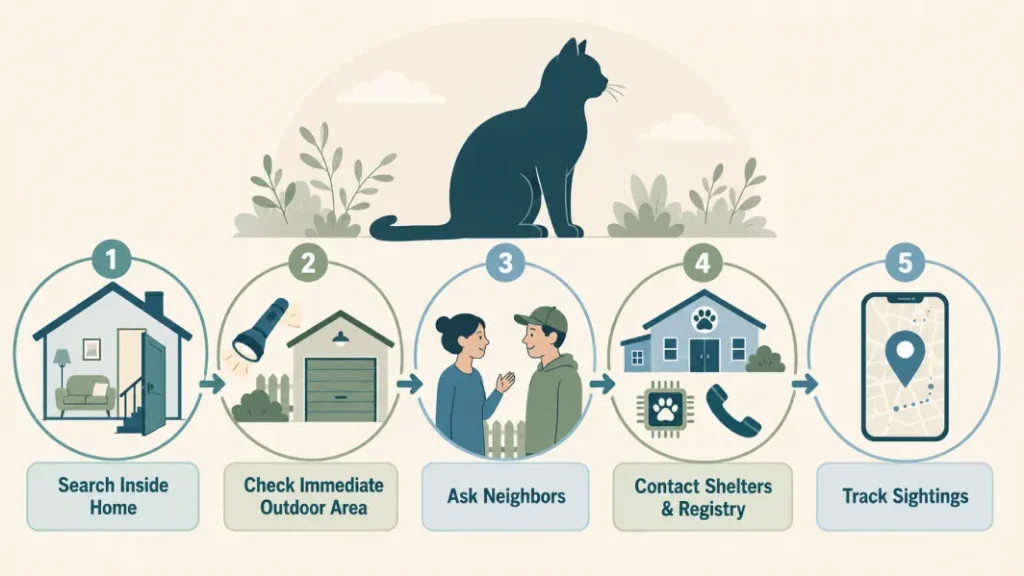
- Secure your other pets and unnecessary exterior doors.
- Search the entire house again.
- Check closets, furniture, boxes, garages and outbuildings.
- Search the immediate outdoor area slowly and carefully.
- Ask neighbors to physically check garages, sheds, decks and yards.
- Contact local shelters, animal control where applicable and nearby veterinary clinics.
- Report your cat missing to the microchip company and confirm your contact information.
- Create a clear missing-cat poster and community post.
- Review doorbell and security-camera footage.
- Record every credible sighting.
- If repeated sightings identify one location, consider an appropriately monitored humane trap with experienced guidance.
Confirm That Your Cat Is Actually Missing
Cats can hide extremely well indoors, particularly when frightened, unwell, sleeping deeply or reacting to visitors or household changes.
Ask everyone in the home:
- When was the cat last definitely seen?
- Which doors or windows were open?
- Were visitors, contractors or deliveries present?
- Was the garage opened?
- Has furniture recently been moved?
- Could the cat have entered a room or cupboard that was later closed?
Do not rely on calling the cat once and assuming silence means they are outdoors.
Secure Other Pets Before Searching
Before repeatedly opening doors, place your other pets somewhere secure.
Tell everyone in the household which exterior doors are being used during the search. Losing another animal while looking for the first makes recovery much more difficult.
Search Inside the House Carefully
Use a flashlight and physically inspect hiding areas instead of standing in the doorway and visually scanning the room.
Check:
- under beds
- behind appliances
- behind bookcases
- inside open drawers
- behind curtains
- under cabinets
- basement areas
- crawl-space access points
- storage spaces
Closets and Cupboards
Look behind clothes, boxes and stored items. Check both floor level and shelves.
A cat may have entered unnoticed before someone shut the door.
Furniture
Inspect:
- under sofas
- hollow furniture bases
- recliners
- sofa-bed mechanisms
- behind mattresses
Do not activate a recliner or folding mechanism until you have confirmed that the cat is not inside it.
Boxes
Open and inspect moving boxes, delivery boxes and other containers that have recently been accessible.
Do not assume a box is empty because you cannot immediately see the cat.
Garages and Outbuildings
Check your own garage, shed and other structures before expanding the search.
Inspect:
- under and around vehicles
- behind stored equipment
- shelves
- cabinets
- dark corners
- rafters where accessible
Ask neighbors to do the same.
Search the Immediate Outdoor Area First
Once you are confident the cat is outside, begin close to the escape point.
A peer-reviewed study of 1,210 missing cats found that cats were frequently recovered close to where they disappeared and that indoor-only cats tended to be found closer than cats accustomed to unsupervised outdoor access.
This does not mean every cat stays within a fixed distance. It means that nearby hiding places deserve a thorough search before you assume the cat has traveled far away.
Look:
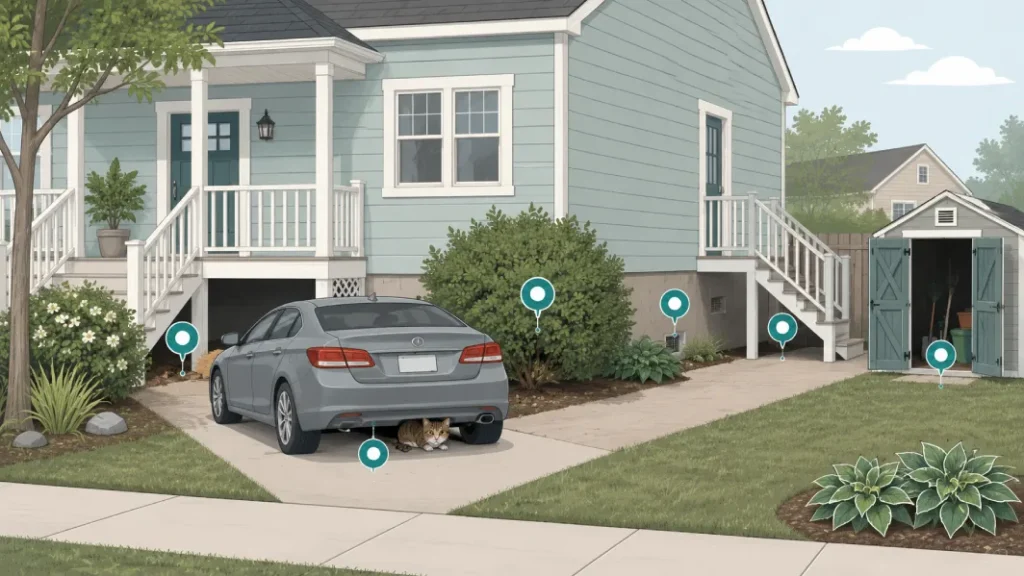
- under porches
- under decks
- beneath parked vehicles
- behind shrubs
- inside dense vegetation
- along foundations
- under exterior stairs
- around fences and walls
- inside accessible sheds and garages
Search slowly and use a flashlight to inspect dark spaces.
If an Indoor-Only Cat Escaped
An indoor-only cat can behave very differently once outside.
The unfamiliar environment may cause the cat to:
- hide close to the escape point
- remain silent
- freeze rather than approach
- avoid unfamiliar people
- move mainly when the area becomes quieter
Peer-reviewed missing-cat research found that indoor-only cats were generally recovered closer to their escape location than cats with regular unsupervised outdoor access.
Do not immediately assume an indoor cat has deliberately traveled a long distance.
If Your Cat Normally Goes Outdoors
A cat accustomed to outdoor access may require a wider investigation.
Consider whether the cat may have:
- been accidentally locked in a shed or garage
- entered a vehicle
- been injured
- been taken in by someone
- been displaced outside familiar territory
- traveled farther than usual
Expand the search while continuing to recheck the immediate neighborhood.
A Frightened Cat May Not Behave Normally
A cat that is affectionate and responsive at home may become quiet and evasive when displaced.
Fear can result in:
- freezing
- hiding
- silence
- running away from people
- remaining under cover
If you see your cat but they retreat, do not interpret that as a failure to recognize you.
Do Not Assume Your Cat Will Respond to Their Name
Continue calling calmly, but do not use the lack of a response as evidence that the cat is not nearby.
Pause frequently and listen.
A frightened or injured cat may stay concealed even when the owner is close.
Avoid sending a large group through the area shouting the cat’s name because additional noise and movement can make a nervous cat remain hidden.
Repeat Searches During Quieter Periods
Search immediately, but also repeat your search when traffic, people and neighborhood activity decrease.
Early morning or later evening can make it easier to:
- hear movement or vocalization
- spot a cautious cat leaving cover
- use a flashlight to inspect dark hiding places
Do not delay the first search while waiting for nighttime.
Ask Neighbors to Physically Check Their Property
Instead of only asking, “Have you seen my cat?” ask neighbors to open and inspect areas where a cat could become trapped.
Ask them to check:
- garages
- sheds
- under decks
- behind outbuildings
- dense shrubs
- crawl spaces
Get permission before entering another person’s property yourself.
Contact Local Shelters and Rescue Organizations
Notify municipal and private shelters in the area.
Provide:
- a clear recent photograph
- cat’s name
- sex
- coat color and pattern
- distinctive markings
- microchip status
- collar information
- date missing
- last known location
- your contact information
Ask each shelter how it handles lost-cat reports and how often you should check found-animal listings.
Do not make one report and assume every later intake will automatically be matched to it.
Contact Animal Control Where Applicable
If your area has municipal animal-control services, file a lost-animal report.
People who find an unfamiliar cat may contact animal control before posting on social media.
Alert Nearby Veterinary Clinics
A finder may take an injured or apparently stray cat directly to a veterinary clinic or emergency hospital.
Send nearby practices:
- a clear photograph
- basic identifying details
- last-seen area
- your contact information
Notify the Microchip Registry
If your cat is microchipped, contact the registry or microchip company and report the cat missing if that service is available.
Check that the registration contains your current:
- phone number
- email address
- home address
- backup contact where available
A microchip is much less useful when the associated contact information is outdated.
Create a Clear Lost-Cat Poster
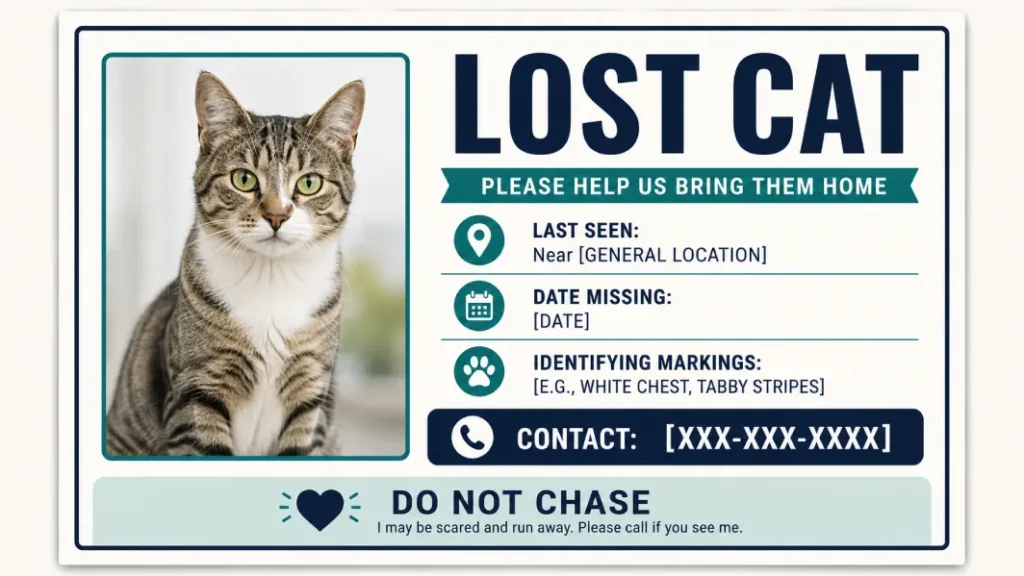
A useful poster should be understandable within a few seconds.
Include:
- a large LOST CAT or MISSING CAT heading
- a clear recent photograph
- last-seen location
- date missing
- important coat markings
- indoor-only status where useful
- DO NOT CHASE if the cat is fearful
- a reliable contact number
Do not overload the flyer with the cat’s entire history.
Use a Recent Photograph
Choose a photograph that shows what your cat currently looks like.
Ideally show:
- face
- full body
- tail
- leg markings
- distinctive patches or patterns
A heavily filtered picture or an old kitten photograph may make recognition harder.
Include Useful Identifying Details
Useful public details can include:
- coat color and pattern
- sex
- approximate size
- collar
- tail characteristics
- obvious markings
Where practical, consider keeping one subtle identifying characteristic private. You can use it later to help verify whether someone claiming to have found your cat has genuinely seen them.
Use Social Media and Community Groups
Share the same clear photograph and basic information with:
- neighborhood groups
- local lost-pet groups
- rescue organizations
- community-cat or TNR groups
- local community forums
Community-cat caregivers can be particularly useful because they often notice unfamiliar cats appearing at established feeding locations.
Ask people to report the exact location and direction of travel rather than chasing a frightened cat.
Check Doorbell and Security Cameras
Review footage from around the time your cat disappeared.
Look for:
- direction traveled
- where the cat crossed a road
- possible hiding locations
- another animal chasing the cat
- a vehicle the cat may have approached
Ask nearby neighbors whether their cameras cover sidewalks, alleys, gardens or driveways.
Keep a Sighting Log
Once several reports begin arriving, do not rely on memory.
Record:
- date
- time
- exact location
- direction of movement
- behavior
- photograph or video availability
- witness
- contact details
- follow-up action
Repeated credible sightings in one area can help you focus physical searches, cameras and trapping efforts.
Using a Humane Trap
A humane box trap may become useful when your cat has been repeatedly sighted in one location but is too frightened to approach.
If you have not trapped cats before, get guidance from an experienced:
- animal shelter
- cat rescue
- TNR organization
- qualified lost-pet recovery professional
Never leave a set humane trap unattended.
A trapped cat cannot escape heat, cold, other animals or interference from people. The trap needs continuous monitoring from an appropriate distance.
Do not use tranquilizer darts, nets or improvised devices that may injure the cat.
Do Not Chase a Frightened Cat
If you see your cat and they retreat:
- Stop moving toward them.
- Reduce noise.
- Do not surround them with several people.
- Record the exact location.
- Watch where they move or hide.
- Use that sighting to plan the next controlled recovery attempt.
A reliable sighting is valuable information even when you cannot immediately pick the cat up.
Be Careful With Scent-Based Lost-Cat Advice
Online advice often claims that putting dirty litter, clothing, bedding or food outdoors will reliably guide a missing cat home.
There is no good evidence that these methods will reliably bring every missing cat back.
Missing Animal Response Network specifically advises against relying on dirty litter as a recovery technique and notes that claims about it are not scientifically established. It also raises the possibility that urine and fecal odors could attract territorial cats, although that proposed risk has not itself been proven in a scientific trial.
The bigger SEO and practical problem with scent advice is that it can encourage owners to wait instead of actively searching.
Prioritize:
- physical searching
- neighbor checks
- camera monitoring
- credible sighting tracking
- appropriately monitored humane trapping when needed
Food can sometimes be used strategically with a camera or humane trap, but an unattended food bowl is not a replacement for searching.
Watch for Lost-Pet Scams
Public lost-pet posts can attract scammers as well as genuine helpers.
Warning signs include:
- urgent demands for money before you see the cat
- gift-card requests
- cryptocurrency requests
- wire-transfer requests
- payment-app pressure
- refusal to provide verifiable information
- fake veterinary or animal-control claims
- requests for text-message verification codes
- guaranteed pet-recovery services demanding upfront payment
Current scam guidance also warns that manipulated or AI-generated photographs and videos can be used as fake evidence.
If Someone Claims to Have Your Cat
- Ask for specific identifying information.
- Request recent photographs or video where reasonable.
- Compare the details with information you kept private.
- If they claim to represent a clinic, shelter or government agency, find the organization’s official contact details independently and call it yourself.
- Do not send money simply because someone is threatening to withhold the cat.
- Never provide an account or verification code sent to your phone.
Keep Proof of Ownership Available
Useful records can include:
- microchip registration
- adoption paperwork
- veterinary records
- photographs of you with your cat
- registration or licensing information where applicable
Do not publish sensitive original documents on a public poster or social-media post.
What to Do When Your Cat Is Found
- Secure the cat in a carrier or closed room.
- Give them a quiet environment.
- Check for obvious injury or illness.
- Update lost-pet databases and shelters.
- Update community posts to say the cat has been found.
- Remove physical posters where appropriate.
- Review how the escape happened.
A frightened cat may remain cautious or hidden after recovery. Avoid forcing interaction immediately.
When Veterinary Assessment Is Appropriate
Contact a veterinarian if your recovered cat:
- has visible injuries
- is limping
- has wounds
- is unusually weak or lethargic
- has difficulty breathing
- is repeatedly vomiting
- has significant diarrhea
- is not eating
- appears dehydrated
- may have been exposed to a toxin
- has missed important medication
- has a chronic medical condition
- does not seem medically normal after returning
Do not assume that every abnormality is simply caused by fear or exhaustion.
Review the Microchip After Recovery
Confirm again that:
- the registration is active
- your phone number is correct
- your address is correct
- the backup contact is useful
Prevent Another Escape
Once the immediate crisis is over, identify how the cat got out.
Possible improvements include:
- repairing damaged window screens
- securing balcony access
- changing front-door routines
- adding an entry barrier
- warning visitors and contractors
- updating identification
- keeping current photographs
- improving carrier training
- reviewing emergency plans
Use How to Cat-Proof Your Home for a room-by-room safety review.
For evacuation planning and identification records, use the Cat Emergency Kit Checklist.
If the escape happened around travel or relocation, see Traveling With a Cat and First Week With a New Cat.
For easier emergency containment, use Cat Carrier Training.
Lost Cat Immediate Action Checklist
Search
- ☐ Confirm when the cat was last seen
- ☐ Secure other pets
- ☐ Search every room
- ☐ Check closets and furniture
- ☐ Check boxes and storage spaces
- ☐ Check garage and outbuildings
- ☐ Search immediate outdoor hiding places
- ☐ Repeat searches during quieter periods
Neighborhood
- ☐ Ask neighbors to check garages and sheds
- ☐ Ask permission to check decks and yards
- ☐ Search beneath vehicles and vegetation
- ☐ Tell people not to chase a frightened cat
Alerts
- ☐ Contact shelters
- ☐ Contact animal control where applicable
- ☐ Contact veterinary clinics
- ☐ Notify the microchip registry
- ☐ Confirm contact details
- ☐ Create a lost-cat poster
- ☐ Post in relevant local groups
Investigation
- ☐ Review security-camera footage
- ☐ Ask neighbors about camera footage
- ☐ Record credible sightings
- ☐ Focus searching around repeated sightings
- ☐ Consider professionally guided humane trapping when appropriate
Scam Protection
- ☐ Keep one identifying detail private where practical
- ☐ Never share verification codes
- ☐ Require credible evidence from anyone claiming to have the cat
- ☐ Independently verify shelters and veterinary clinics
- ☐ Do not send money based only on threats or unverifiable claims
Lost Cat Sighting Tracker
| Date | Time | Exact Location | Direction | Behavior | Photo/Video | Witness | Contact | Follow-Up |
|---|---|---|---|---|---|---|---|---|
| _____ | _____ | ________________ | ________ | ________________ | Yes / No | ____________ | ____________ | ____________ |
| _____ | _____ | ________________ | ________ | ________________ | Yes / No | ____________ | ____________ | ____________ |
| _____ | _____ | ________________ | ________ | ________________ | Yes / No | ____________ | ____________ | ____________ |
Give more weight to sightings supported by a clear photograph, video or detailed description at a plausible location. Vague reports without a time or exact location should not automatically redirect the entire search.
FAQs
How far away should I search for a lost indoor cat?
Start very close to the escape point and physically inspect hiding places before expanding outward. Research found that indoor-only cats were generally recovered closer to where they disappeared than cats accustomed to unsupervised outdoor access. Do not turn study averages into a guaranteed search radius for an individual cat.
Will my lost cat come when I call?
Possibly, but do not depend on it. A frightened, displaced or injured cat may remain silent even when you are nearby. Call calmly, pause to listen and continue physically checking hiding places.
Should I put my cat’s dirty litter box outside?
Do not treat dirty litter as a proven recovery method. There is no reliable evidence that it will guide every missing cat home, and relying on it can distract from more useful actions such as physical searching, neighbor checks, cameras and appropriately monitored trapping.
What should I do if I see my cat but they run away?
Do not chase. Stop advancing, reduce noise and note exactly where the cat goes. A confirmed sighting can help you focus quiet searches, camera monitoring or a controlled humane-trapping plan.
How often should I check local shelters?
Check repeatedly and follow each shelter’s own lost-pet procedure. Do not assume that one initial report guarantees that every future cat brought into the facility will automatically be matched to your description.
How can I tell whether someone claiming to have my cat is a scammer?
Ask for verifiable information, request current evidence and independently contact any clinic or shelter they claim to represent. Never provide verification codes, and treat urgent demands for gift cards, cryptocurrency, wire transfers or payment before seeing the cat as major warning signs.
Bottom Line
If your cat is missing, start with an active physical search rather than assuming they have traveled far away.
Search the house thoroughly, inspect nearby hiding places, ask neighbors to check garages and sheds, alert shelters and veterinary clinics, update the microchip registry, review cameras and record reliable sightings.
Do not chase a frightened cat, and do not replace physical searching with unproven scent tricks. A cat that is silent can still be very close to home.
Sources
- ASPCA — Finding a Lost Pet
- Huang et al., Animals (2018) — Search Methods Used to Locate Missing Cats and Locations Where Missing Cats Are Found
- Pet FBI — Lost Cat Recovery and Lost Pet Scam Guidance
- Missing Animal Response Network — Lost Cat Behavior and Kitty Litter Myth
- Alley Cat Allies — Humane Trap Safety Guidance
- CDC — Pet Identification and Emergency Preparedness
- Federal Trade Commission — Pet and Verification-Code Scam Guidance