
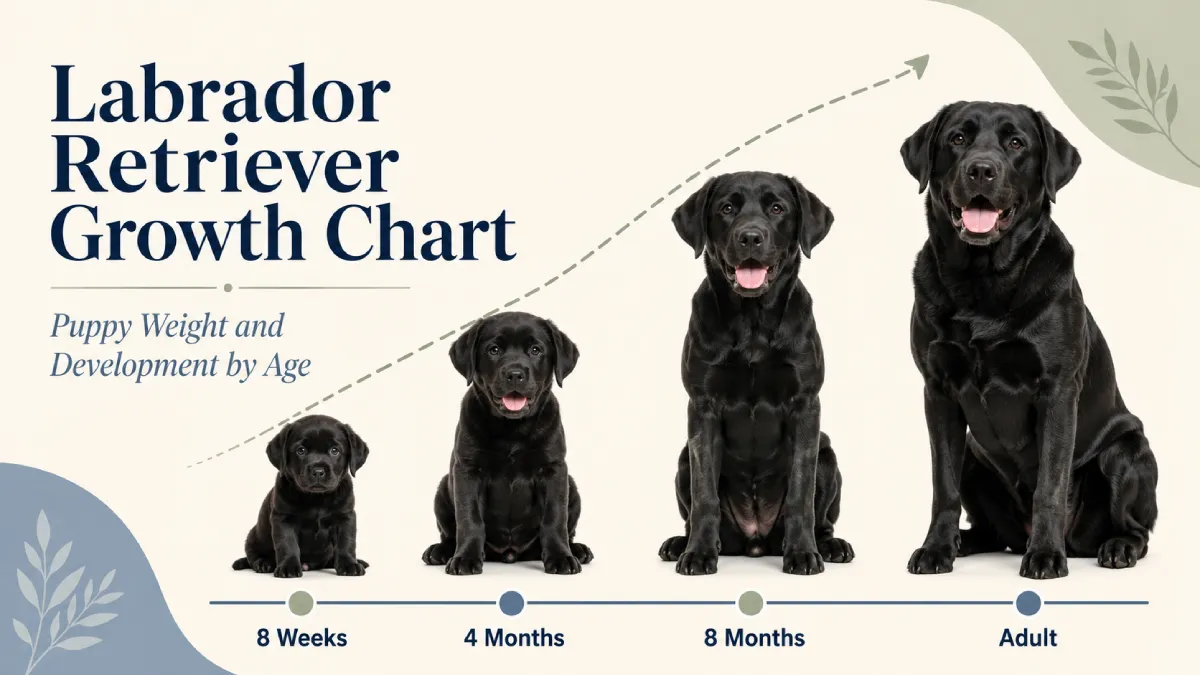
Labrador Growth Chart: Puppy Weight and Development by Age
A Labrador growth chart is most useful when it shows whether your puppy is following a steady personal growth pattern rather than whether it matches one fixed weight at a particular month. Labrador puppies grow rapidly during their first year, but healthy dogs of the same age can differ because of sex, genetics, body type, nutrition and other individual factors. Large-scale veterinary research has found substantial individual variation even among healthy growing dogs. To follow your own Lab more closely, you can record and compare your puppy’s weights over time instead of judging progress from a single age checkpoint.
For adult reference, the Labrador Retriever Club standard lists males at approximately 65–80 pounds and females at 55–70 pounds when in working condition. Those are adult breed-standard references, not targets that puppies should be overfed to reach.
Quick Answer
Labradors gain weight quickly during puppyhood and then more gradually as they approach physical maturity. Most large-breed dogs reach adult size somewhere around 12–18 months, although final bodyweight and mature proportions may continue developing later. Monitor your Lab’s weight trend together with body condition rather than chasing an average puppy weight from an online chart.
Labrador Growth Overview
Research based on thousands of Labradors in veterinary practice found that the breed gains weight rapidly during the first year, with males eventually plateauing at a higher average adult bodyweight than females. This supports using sex-specific context while still recognising wide individual variation.
The Labrador Retriever Club’s adult standard gives the following reference:
| Sex | Adult Height at Withers | Approximate Adult Weight |
|---|---|---|
| Male | 22½–24½ inches | 65–80 lb |
| Female | 21½–23½ inches | 55–70 lb |
The standard specifies these weights for dogs in working condition and also states that Labradors should be well muscled without excess fat.
Labrador Growth Chart by Age
There is no official Labrador Retriever Club table requiring a puppy to weigh a particular number at 8 weeks, 4 months or 7 months. Veterinary growth standards instead follow a trajectory over repeated measurements.
Use this chart as a monitoring framework rather than a list of target weights:
| Age | Development Pattern | What to Monitor |
|---|---|---|
| Birth–8 weeks | Very rapid early growth, nursing and weaning | Consistent gain, breeder/vet records, general condition |
| 2–4 months | Fast skeletal and body growth | Establish baseline weight and BCS |
| 4–6 months | Major increase in frame and height | Weight curve, waist, ribs, food amount |
| 6–9 months | Continued rapid growth and adolescence | Avoid excess calorie-driven gain |
| 9–12 months | Growth continues but often begins slowing | Weight trend and body condition |
| 12–18 months | Later skeletal and body development | Adult-size transition, muscle and condition |
| 18+ months | Mature body composition becomes clearer | Maintain healthy adult condition |
| Adult reference | Full working-condition size | Male 65–80 lb; female 55–70 lb |
The absence of fixed puppy weights is intentional. Evidence-based growth charts are designed to determine whether a puppy follows a reasonable curve, not whether every Labrador reaches the same number on the same date.
Birth to 8 Weeks
During the first weeks of life, Labrador puppies are developing extremely quickly. Early weight monitoring is particularly useful because it can reveal whether an individual puppy is gaining consistently relative to its own starting point and littermates. Research in Labradors has also shown that birth weight varies with factors including sex, litter size and maternal characteristics.
By around eight weeks, puppies are generally weaned and moving toward a complete puppy diet. VCA notes that puppies are typically weaned by approximately this stage.
A breeder’s serial weights are much more useful here than a generic internet number.
2 to 4 Months
Once your Labrador is home, start creating a personal growth record.
Record:
- age
- weight
- food being fed
- amount being fed
- body condition
- activity
- veterinary observations
This period usually involves fast weight gain, but faster is not necessarily better. Veterinary nutrition guidance describes the goal as optimal, steady growth, rather than maximal growth produced by excess calories.
4 to 6 Months
The puppy’s frame can change noticeably during these months.
Legs may become longer, the torso develops and body proportions may temporarily look less adult. What matters nutritionally is whether weight gain remains compatible with an appropriate body condition.
Large-breed puppies are particularly sensitive to excessive calorie intake because accelerated growth and excess weight can increase orthopedic risk.
Use Pawnium’s Puppy Feeding Guide for the detailed feeding schedule rather than calculating food from the growth chart alone.
6 to 9 Months
Growth is still active during this period, even though the puppy may already look large.
AAHA describes cessation of the most rapid puppy growth as variable by breed and body size, while veterinary guidance notes that large dogs mature more slowly than small and medium dogs.
Continue weighing periodically and watch the body itself.
The scale should not be the only metric.
9 to 12 Months
Around the first birthday, many Labradors look convincingly adult from a distance, but appearance does not necessarily mean skeletal and body development are complete.
The official Labrador standard even excludes dogs under 12 months from its minimum adult height requirements, reinforcing that younger dogs should not be judged as finished adults.
Continue monitoring growth rather than automatically switching every Labrador to an adult feeding strategy on its first birthday.
12 to 18 Months
For many large-breed dogs, later skeletal development continues into this period. VCA places adult size for most large breeds broadly between 12 and 18 months, while nutrition guidance recognises that some large dogs require growth-formulated nutrition beyond one year.
Your veterinarian can help determine when your individual Labrador has reached the appropriate point to transition from growth nutrition to adult maintenance.
Male Versus Female Variation
Male Labradors are generally larger than females.
The official standard lists:
Males
- 22½–24½ inches
- approximately 65–80 pounds
Females
- 21½–23½ inches
- approximately 55–70 pounds
Veterinary population research also found male Labradors had a higher adult bodyweight than females.
That does not mean a male puppy should automatically be fed more simply because he is male. Intake should still be adjusted according to growth, body condition, activity and the food’s calorie density.
Field-Type Versus Show-Type Variation
There is only one Labrador Retriever breed, not separate official “English” and “American” breeds.
The Labrador Retriever Club explains that different breeding lines can produce different body styles. Working or field Labradors are often lighter in bone and longer in leg, while conformation or show lines are often stockier and heavier in bone. The club also stresses that most Labradors are moderate rather than extreme examples of either style.
This matters for a growth article because two healthy adult Labs can look noticeably different even at similar heights or weights.
However, there are not separate official field-Lab and show-Lab adult weight standards. Both belong to the same breed and are referenced against the same Labrador standard.
Genetics
Genetics strongly influence frame, mature size and growth trajectory.
Research on Labrador puppies has found measurable inherited and maternal influences on early weight, while broader canine growth studies show considerable individual variability even among dogs raised in healthy condition.
Knowing the size and build of healthy parents can therefore provide useful context, but it does not create a precise prediction of adult weight.
Nutrition
Growing Labs need sufficient nutrition without excessive energy.
VCA recommends feeding puppies for optimal rather than maximal growth. Overfeeding and free-choice access to calorie-dense food can speed weight gain and increase the risk of excess body fat and developmental orthopedic problems.
For a large-breed puppy, choose a complete diet appropriate for growth and discuss substantial feeding adjustments with your veterinary team.
Do not keep adding food simply because another Labrador of the same age weighs more.
Activity
Activity affects energy needs, muscle development and body condition.
Puppies need opportunities to walk, explore and play, but developing joints and growth plates are still maturing. VCA recommends avoiding forced high-impact or strenuous activities such as long-distance jogging, lengthy hikes or repetitive jumping until sufficient maturity.
Use Pawnium’s Puppy Exercise Chart for age-specific activity guidance.
Body Condition
A healthy number on the scale can still be misleading without body-condition assessment.
AAHA’s nine-point BCS system places approximately 4–5/9 within the ideal range. Large-breed puppy guidance particularly emphasises keeping growing dogs lean and avoiding excessive body fat.
At an appropriate condition:
- ribs should be easy to feel without heavy fat covering
- a waist should be visible from above
- the body should not look barrel-shaped from excess fat
Your veterinarian can confirm your puppy’s BCS so home monitoring starts from a reliable baseline.
Growth Spurts
Puppy growth is not perfectly linear.
Evidence-based growth curves are curved because the rate of weight gain changes throughout development. A puppy may appear to gain quickly during one phase and more slowly during another.
A single unusual measurement is therefore less informative than several measurements showing a sustained change in direction.
Research comparing healthy and unhealthy growth patterns found that repeatedly crossing multiple growth-centile lines was more common in dogs that later became overweight, underweight or had conditions affecting growth.
When Labradors Reach Adult Height
There is no authoritative rule stating that every Labrador stops getting taller on one exact birthday.
The Labrador standard’s adult height criteria are not applied to dogs under 12 months, while veterinary large-breed guidance places final adult size broadly around 12–18 months.
Height growth usually becomes less dramatic before final mature body composition is established.
That is why a one-year-old Lab can appear nearly adult-sized while still changing physically.
When Labradors Fill Out
“Filling out” refers more to mature muscle, chest, bone appearance and overall body composition than to simply getting taller.
Large dogs may continue toward adult bodyweight after the fastest height growth has slowed, and canine growth studies follow large dogs through as late as two years for this reason.
So the answer to when do Labs stop growing is not one exact month.
Think instead in stages:
rapid puppy growth → slowing height growth → later body and muscle maturation
Preventing Excessive Puppy Weight
Labradors should grow steadily, not as quickly as possible.
Excess calorie intake during growth can create faster-than-optimal weight gain and excess fat. Large-breed puppy guidance recommends measured meals and regular adjustments based on growth and body condition rather than unrestricted feeding.
Also count:
- treats
- training rewards
- chews
- table food
- food provided by other family members
The Labrador breed standard itself describes the correct adult as well-muscled and without excess fat.
How to Weigh a Labrador Puppy at Home
For a very young puppy, an appropriately sized pet scale may work.
As your Lab becomes larger:
- Use a pet or veterinary scale when available.
- Use the same scale for repeat measurements when practical.
- Weigh under similar conditions.
- Record the date and age.
- Record BCS beside the number.
- Compare the trend with previous weights.
Regular weigh-ins and body-condition assessments are recommended tools for monitoring healthy puppy growth.
Avoid getting concerned over tiny day-to-day differences.
The trend is what matters.
Monitoring Body Condition
The most useful Lab puppy weight chart combines weight with body condition.
For every weigh-in, ask:
- Are the ribs still easy to feel?
- Is the waist visible?
- Is body fat clearly increasing?
- Does the puppy look progressively bonier?
- Is muscle development appropriate?
- Has appetite changed?
AAHA considers BCS below 4/9 or above 5/9, muscle loss and unexplained weight change reasons for additional nutritional assessment.
Growth That Seems Too Slow
Do not diagnose slow growth from one low chart position.
Some healthy Labradors are simply smaller than others.
More useful concerns include:
- weight repeatedly moving downward relative to the puppy’s previous trajectory
- poor or reduced appetite
- persistent vomiting or diarrhoea
- body condition becoming too lean
- loss of muscle
- low energy
- poor development noted during veterinary examinations
Research on canine growth curves found that sustained downward movement across multiple centile lines was more common in dogs that became underweight or had disorders affecting growth. The growth chart itself, however, is not a diagnostic test.
Rapid Weight Gain
A puppy becoming heavier quickly is not automatically a sign of excellent health.
Repeated upward movement through growth centiles can indicate a faster-than-expected growth trajectory. Research found this pattern was more common in dogs that later became overweight or obese.
Look especially for:
- waist becoming less visible
- ribs becoming harder to feel
- BCS increasing
- food portions creeping upward
- large amounts of treats
- reduced activity
Do not reduce a growing puppy’s nutrition aggressively on your own. Adjust the feeding plan with veterinary guidance.
When to Consult a Veterinarian
Discuss growth with your veterinarian if:
- your puppy repeatedly loses weight
- weight gain unexpectedly stops
- BCS falls below the ideal range
- BCS continues increasing above the ideal range
- weight rises unusually quickly
- vomiting or diarrhoea persists
- appetite becomes poor
- the puppy develops persistent limping or pain
- growth differs markedly from its previous veterinary trend
AAHA considers unexplained weight change and abnormal body condition nutritional risk factors that warrant more detailed assessment.
Bring your growth record with you. A sequence of weights is usually more informative than telling the veterinarian that your Lab “looks small.”
FAQs
How much should a Labrador puppy weigh at each age?
There is no single official Labrador weight that every puppy should reach at every month. Evidence-based veterinary growth tools follow repeated weight measurements along a trajectory rather than using one mandatory age-specific number. Sex and individual variation also influence Labrador growth.
How big do Labradors get?
The Labrador Retriever Club standard lists adult males at approximately 65–80 pounds and 22½–24½ inches tall. Females are approximately 55–70 pounds and 21½–23½ inches.
When do Labs stop growing?
There is no exact age for every Labrador. Large-breed dogs commonly approach adult size between about 12 and 18 months, while bodyweight and mature proportions may continue developing afterward.
Is my Labrador too small if it is below an online weight chart?
Not necessarily. Online averages do not account for genetics, sex, field versus show-style build or individual growth trajectory. Body condition and serial weight measurements are more useful than one comparison number.
Should I feed my Labrador puppy more to make it grow faster?
No. The goal is optimal, controlled growth rather than maximal growth. Excess calories can increase body fat and accelerate development in ways that may increase orthopedic risk in large-breed puppies.
Are field Labs smaller than show Labs?
Not according to separate official standards—there is only one Labrador Retriever breed. The Labrador Retriever Club does recognise style differences: working/field dogs are often lighter-boned and longer-legged, while show/conformation dogs may appear stockier and heavier-boned. Individual variation remains considerable.