
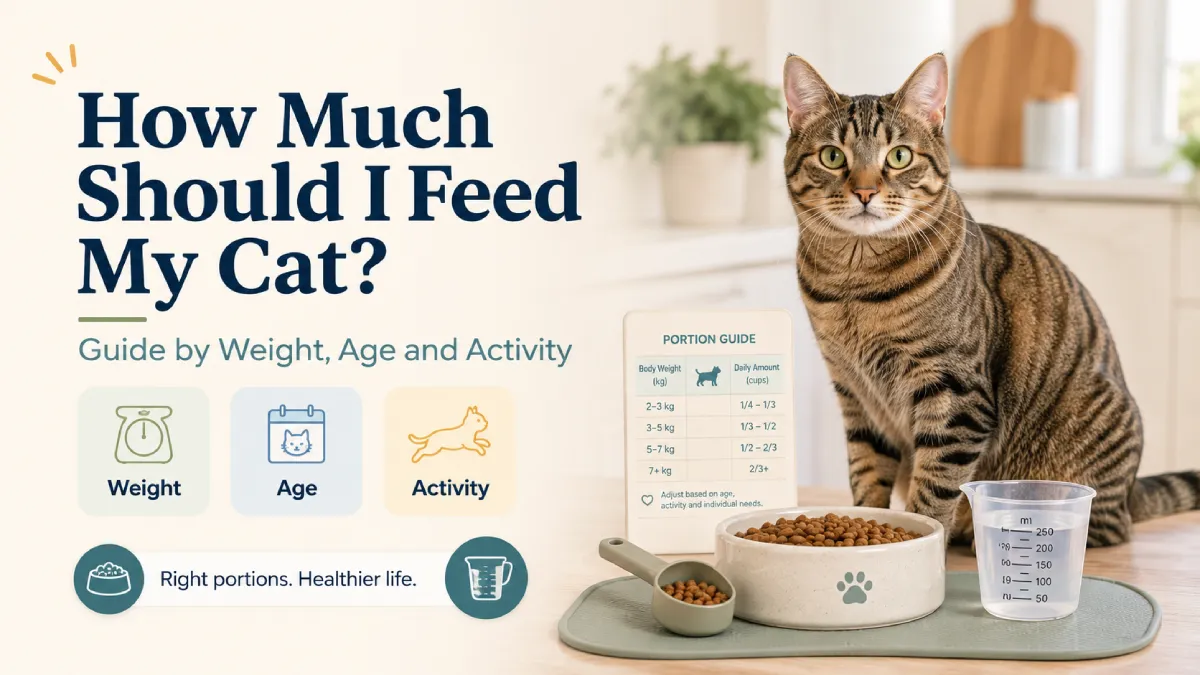
How Much Should I Feed My Cat? Guide by Weight, Age and Activity
How much should I feed my cat? The answer depends on more than the number on the scale. Age, ideal weight, body condition, muscle condition, activity, neuter status, health, treats and the calorie density of the food all affect how much an individual cat needs. Veterinary nutrition guidance therefore recommends assessing the cat, the diet and the feeding routine together rather than using one universal portion.
Start with the calorie information and feeding directions on a complete and balanced food, then adjust the amount according to your cat’s weight and body-condition trend. A cat that steadily gains weight may be receiving too much energy, while unexplained weight loss or difficulty maintaining condition deserves veterinary assessment rather than simply adding food.
Quick Answer
There is no single correct number of cups, cans or grams for every cat. An appropriate feeding amount is based on the cat’s ideal body condition and individual energy needs, then converted into a portion using the calorie content of the specific food. Package feeding directions provide a starting point, but portions should be reassessed using weight, body condition and muscle condition over time.
Why There Is No Universal Portion
Two cats that weigh the same can need different amounts of food.
Factors that affect energy needs include:
- age
- reproductive status
- whether the cat is spayed or neutered
- activity
- body condition
- muscle condition
- health status
- lifestyle
- calorie density of the diet
AAHA and AAFP specifically recommend basing feline nutrition plans on age, reproductive status, BCS, MCS, activity and health rather than body weight alone.
This is why advice such as “every 10-pound cat needs one cup per day” is unreliable. One cup of one dry food can contain substantially different calories from one cup of another, and a sedentary overweight cat does not have the same feeding goal as a lean, highly active cat of identical weight.
Cat Feeding Chart Overview
Use this cat feeding chart as a decision framework, not a universal serving chart.
| Cat’s Situation | Starting Point | What Determines the Final Portion |
|---|---|---|
| Healthy adult at ideal condition | Food label or individualized calorie target | Weight trend, BCS, MCS, activity and food calories |
| Over ideal body condition | Veterinary weight-management assessment | Target weight, body condition, health and safe calorie plan |
| Under ideal body condition | Veterinary assessment if unexplained | Cause of low weight, muscle condition, food intake and health |
| Recently neutered/spayed | Reassess current portion | Weight trend, appetite, activity and BCS |
| Highly active cat | Individualized estimate | Actual activity and ability to maintain ideal condition |
| Sedentary indoor cat | Individualized estimate | Body condition and weight trend rather than indoor status alone |
| Kitten | Growth-specific feeding plan | Age, growth and kitten diet |
| Pregnant/nursing queen | Reproduction/growth feeding plan | Stage of pregnancy or lactation and veterinary guidance |
| Mature or senior cat | Review current intake regularly | Weight, muscle condition, appetite and health changes |
The table intentionally does not assign a fixed cup or can amount by weight. The correct physical portion depends on how many calories are contained in the particular food being fed.
Current Weight
Current weight is useful, but it is only one part of the feeding assessment.
Record the weight consistently and compare it with previous measurements. A stable weight in a cat with ideal body and muscle condition suggests that current intake may be reasonably matched to expenditure. A steady upward or downward trend tells you the plan needs another look.
Cat food portions by weight therefore should not be created from current weight alone.
An overweight cat’s current weight, for example, is not automatically the weight that should be used as the long-term feeding goal.
Ideal Weight
Ideal weight is the weight at which an individual cat maintains an appropriate body composition.
That number is not identical for every cat of a particular breed, sex or frame size.
Cornell recommends working with a veterinarian to determine the individual cat’s ideal weight and then adjusting intake to reach or maintain it.
If your cat is overweight, avoid choosing an arbitrary target from a breed-weight chart online. Body condition and muscle condition provide important context that scale weight cannot supply.
Body Condition
Body condition score, or BCS, estimates body-fat stores.
On a commonly used nine-point scale, an ideal cat has a visible waist from above and ribs that can be felt beneath a light fat covering. Cornell describes 5/9 as an example of ideal condition on this scale.
The practical question is:
Is your cat maintaining the body condition your veterinary team considers appropriate?
If not, the portion may need adjustment even when the number on the food package seems correct.
Muscle Condition
Muscle condition should be assessed separately from body fat.
A cat can be overweight while losing muscle, particularly with ageing or illness. AAHA recommends using both BCS and muscle condition score when evaluating nutrition rather than relying only on body weight.
This becomes particularly important in older cats, where apparent weight stability can sometimes hide a change in the balance between fat and lean tissue.
Age
A cat’s nutritional needs change throughout life.
AAHA and AAFP define the main age-related stages as:
- kitten: birth to 1 year
- young adult: 1–6 years
- mature adult: 7–10 years
- senior: over 10 years
These age categories are useful starting points rather than rigid biological boundaries. Individual health and body condition still determine the final feeding plan.
Activity
More active cats may use more energy than sedentary cats, but activity is difficult to estimate from labels such as “playful” or “lazy.”
Consider what the cat actually does.
Does it:
- roam outdoors
- climb and play frequently
- use puzzle feeders
- chase toys daily
- spend most of the day resting
Young active adults may have higher energy requirements than some older cats, which is another reason two same-weight cats may require different portions.
Indoor Versus Outdoor Lifestyle
Do not assume that every indoor cat requires the same calorie allowance.
Some indoor cats are extremely active. Others have little opportunity for movement and may be more prone to eating out of boredom.
Outdoor access adds another complication because the owner may not know whether the cat is:
- hunting
- receiving food from neighbours
- accessing another pet’s food
AAHA specifically recommends considering outdoor access and unrecorded food sources when assessing whether a feeding plan matches actual intake.
Lifestyle should therefore modify the feeding assessment rather than dictate a fixed amount.
Neutered or Spayed Cats
Spaying and neutering can change energy balance and increase the risk of weight gain in cats.
AAHA identifies neutering as an obesity risk factor and recommends reassessing calorie intake and monitoring body condition after the procedure.
Do not automatically cut every neutered cat’s food by the same percentage.
Instead, monitor:
- body weight
- BCS
- appetite
- activity
and adjust the portion according to the individual cat’s response.
Pregnancy and Nursing
Pregnant and nursing cats have very different nutritional needs from ordinary adult-maintenance cats.
Energy requirements increase during pregnancy and can rise substantially during lactation. Veterinary guidance generally recommends a complete and balanced diet appropriate for growth/reproduction during this period rather than simply increasing an ordinary adult-maintenance diet without considering nutrient density.
Pregnant or nursing queens should have an individualized feeding plan with veterinary guidance.
Do not use the standard adult cat feeding chart for them.
Food Calorie Density
The physical amount of food matters less than the calories contained in it.
A small amount of calorie-dense dry food may provide similar energy to a much larger volume of a lower-calorie wet food.
AAFCO requires calorie information to be expressed as kilocalories per kilogram and per familiar household unit, such as:
- kcal per cup
- kcal per can
- kcal per pouch
- kcal per treat
depending on the product.
This calorie statement is the bridge between your cat’s daily energy target and the actual amount placed in the bowl.
Reading Manufacturer Feeding Directions
Complete and balanced commercial cat foods provide feeding directions.
These usually relate:
cat weight → amount of food → feeding period
and may also separate instructions by life stage.
Read the directions together with:
- calorie content
- nutritional adequacy statement
- life-stage designation
For an adult cat, make sure the food is nutritionally appropriate for adult maintenance unless your veterinarian has advised otherwise. FDA explains that a “complete and balanced” nutritional adequacy statement indicates that the product is intended to provide the necessary nutrients for the specified life stage.
Why Feeding Guides Are Starting Points
Package feeding guides are useful, but they cannot account perfectly for every cat’s metabolism and lifestyle.
AAFCO explicitly describes feeding directions as guidelines that may need modification for an individual animal. AAHA similarly advises monitoring weight, body condition and muscle condition rather than relying on package recommendations alone.
If your cat is:
- gaining unwanted weight
- losing weight
- becoming underconditioned
- losing muscle
the appropriate response is to reassess the feeding plan rather than assuming the printed serving must be correct.
Feeding Kittens
Kittens need food formulated for growth because their energy and nutrient requirements differ substantially from adult maintenance needs.
Do not use this adult cat feeding guide to calorie-restrict a growing kitten.
AAHA recommends a growth-appropriate diet through kittenhood, generally until around 1 year of age in cats.
Keep the detailed age-based amounts, meal frequency and developmental feeding schedule on Pawnium’s dedicated Kitten Feeding Schedule page.
Feeding Young Adult Cats
Young adult cats are approximately 1–6 years old under the AAHA/AAFP life-stage framework.
This is an important period for preventing gradual weight gain.
AAHA recommends:
- monitoring weight
- monitoring BCS
- considering neuter status
- accounting for activity
- controlling total caloric intake
because free-choice feeding and declining activity can contribute to excess intake.
A young adult cat at ideal condition can usually be managed by establishing an appropriate daily ration and then adjusting it according to weight and BCS trends.
Feeding Mature Cats
Mature adult cats are approximately 7–10 years old in the AAHA/AAFP framework.
Do not automatically reduce food solely because the cat turned seven.
Monitor for both:
- weight gain
- weight loss
and pay increasing attention to muscle condition, appetite and health changes. AAHA notes that the feeding needs of mature cats vary individually rather than following one universal age-based reduction.
Feeding Senior Cats
Cats older than 10 are classified as senior under the AAHA/AAFP framework.
A common mistake is assuming that all older cats automatically need fewer calories.
Some seniors become less active and gain weight, while others have difficulty maintaining body weight or muscle condition. AAHA notes that underweight status can become an important concern in older cats and that age-related changes in digestion and disease can alter nutritional needs.
Track:
- weight
- BCS
- MCS
- appetite
- eating comfort
and link to Pawnium’s Senior Cat Content once available.
Wet-Food Portions
Wet food commonly contains considerably more water than dry food, so comparing the two by volume is misleading.
FDA notes that canned pet foods typically contain much more moisture than dry diets.
Use the kcal per can or pouch, not the size of the container alone.
For example, two same-sized cans can contain different calorie amounts.
Once you know the cat’s daily calorie target, the label’s calorie statement tells you how much of that specific wet food fits into the daily plan.
Link detailed format comparisons to Pawnium’s Wet Versus Dry Cat Food guide.
Dry-Food Portions
Dry food is often calorie-dense, making apparently small differences in volume meaningful.
Avoid repeatedly filling a bowl by eye.
AAHA recommends weighing dry food with a gram scale when precision matters because weight-based measurement is more accurate than relying on measuring cups.
If the label lists calories per cup, you can still use that information to plan the ration, but weighing the final daily portion can improve consistency.
Mixed Feeding
Cats can be fed a combination of wet and dry food.
The key is that both components count toward the same total daily calorie allowance.
Do not:
- give the full recommended dry ration, and then
- add the full recommended wet ration on top.
That can unintentionally provide substantially more energy than intended.
Instead, calculate how much of the daily calorie target comes from each food.
Detailed nutritional and hydration trade-offs should remain on Pawnium’s Wet Versus Dry Cat Food page.
Number of Meals Per Day
How often should cats eat?
There is not one mandatory meal frequency for every healthy adult cat. Cornell notes that feeding frequency depends on age, health and individual preferences, while feline feeding guidance encourages offering multiple small meals that better reflect normal feline feeding behaviour.
The important distinction is between:
daily allowance and meal size.
Determine the total amount for the day first, then divide that ration into a practical number of meals.
Free Feeding
Free feeding means leaving food continuously available.
This works for some cats that regulate intake well, but it can make portion control and intake monitoring difficult.
AAHA identifies free-choice feeding as a potential contributor to overconsumption, particularly in cats already at risk of excess weight.
If you free feed, measure the entire daily ration rather than repeatedly topping up an unlimited bowl.
That gives you a way to track actual intake.
Scheduled Feeding
Scheduled feeding provides measured portions at planned times.
Benefits can include:
- clearer portion control
- easier appetite monitoring
- easier identification of food stealing
- a predictable household routine
Feline feeding consensus guidance recommends multiple small meals and individualized feeding arrangements rather than assuming one feeding style works for every cat.
A cat feeding schedule can therefore be adapted around the household while keeping the daily ration consistent.
Automatic Feeders
Automatic feeders can divide a measured daily ration into smaller meals without requiring someone to be home at every feeding.
They may be particularly useful for:
- cats that eat small meals
- overnight feeding
- portion control
- multi-cat homes
AAHA also notes that automated or microchip/collar-controlled feeders can help prevent one animal from consuming another pet’s food.
The feeder should dispense part of the pre-calculated daily ration, not additional food.
Measuring Portions Accurately
Eyeballing is one of the easiest ways for portions to drift upward.
For dry food, weighing the portion in grams is more precise than repeatedly estimating it with a cup.
A simple routine is:
- determine the daily amount
- weigh the whole day’s ration
- place it in a container
- distribute meals only from that container
For wet food, use the calorie content per can or pouch and record partial-container amounts consistently.
Treat Calories
Treats count.
They should not be added as though they contain no energy.
AAHA recommends that the primary complete and balanced diet provide at least 90% of total calorie intake, with treats and other supplemental foods generally limited to no more than 10%.
Treat calories can come from:
- packaged treats
- table food
- lickable snacks
- food used to give medication
Include all of them when assessing the cat food amount per day.
Multi-Cat Households
A shared bowl makes it difficult to know how much each cat actually consumes.
One cat may:
- eat quickly
- guard the feeding area
- eat another cat’s leftovers
while a more timid cat may not receive enough.
The FelineVMA feeding consensus recommends individualized feeding spaces and recognizes that cats naturally prefer eating in a relatively solitary manner.
Separate feeding also makes appetite changes easier to detect.
Preventing Food Stealing
Useful strategies include:
- separate feeding locations
- closing doors during meals
- removing leftovers after scheduled meals
- microchip-controlled feeders
- collar-activated feeders
AAHA specifically recommends separate feeding or individualized automatic feeders when one pet consumes another’s food.
Do not simply reduce the slower cat’s ration because another cat keeps stealing it.
Solve the access problem first.
Monitoring Body Weight
A feeding plan is not finished once the portion has been calculated.
Track:
- weight
- BCS
- MCS
- appetite
- activity
over time.
AAHA describes nutritional assessment as an ongoing process rather than a one-time calculation.
If the cat maintains ideal body and muscle condition, the current intake may be appropriate even if it differs from another same-weight cat’s ration.
Signs of Overfeeding
Possible clues that calorie intake exceeds needs include:
- progressive weight gain
- loss of a visible waist
- increasing fat covering over the ribs
- rising BCS
Body condition is more informative than simply deciding that a cat “looks big.”
If weight continues increasing despite apparently appropriate portions, confirm that you have counted:
- treats
- food stealing
- multiple feeders
- food given by other household members
- outdoor food sources
before making a major restriction.
Signs of Underfeeding
Too little intake may contribute to:
- declining body weight
- falling body condition
- poor ability to maintain muscle
but unexplained weight loss should not automatically be treated by simply increasing food.
Cats can lose weight because of medical disease even while eating normally or eating more than usual. Cornell advises veterinary assessment when a cat is losing weight or refusing food.
Use Pawnium’s Why Is My Cat Always Hungry? or Why Is My Cat Not Eating? guide according to the pattern.
Adjusting Portions Gradually
Small portion adjustments are generally easier to monitor than repeatedly making large changes.
After modifying the ration, track weight and body condition consistently and reassess the trend.
If you are also changing the type of food, AAHA recommends transitioning diets gradually rather than switching abruptly when circumstances allow.
Keep the detailed transition method on Pawnium’s Cat-Food Transition Guide.
Weight-Loss Cautions
Do not create an aggressive home calorie restriction for an overweight cat.
Cats are vulnerable to hepatic lipidosis when food intake falls drastically, making rapid or poorly supervised weight-loss attempts potentially dangerous.
An overweight cat should have:
- an appropriate target weight
- a veterinary feeding plan
- measured food
- regular weight monitoring
- reassessment of BCS and MCS
Do not simply halve the normal food portion.
Do not calorie-restrict kittens for adult-style weight loss.
Weight-Gain Cautions
An underweight cat should not automatically receive unlimited high-calorie food until the reason for the weight loss is understood.
Weight loss can accompany medical disease, dental pain, reduced appetite and other problems.
Veterinary assessment becomes particularly important when weight loss is:
- unexplained
- continuing
- accompanied by increased hunger
- accompanied by reduced appetite
- associated with vomiting or diarrhoea
- occurring in a senior cat
A nutrition plan should address both the calorie need and the reason the cat became underweight.
Medical Conditions Affecting Food Needs
Medical conditions can substantially alter calorie needs, nutrient requirements or feeding schedules.
Examples include disorders affecting:
- kidneys
- gastrointestinal tract
- thyroid function
- glucose regulation
- dental comfort
AAHA’s current feline diabetes guidance, for example, recommends individualized calorie and portion control based on body weight, body condition, muscle condition and concurrent disease.
Do not use this general adult-cat feeding guide to select a prescription or therapeutic diet.
If a cat has a diagnosed disease, follow the feeding plan supplied by the veterinary team managing that condition.
When Veterinary Nutrition Advice Is Needed
Ask your veterinarian for an individualized feeding plan if your cat:
- is overweight or obese
- is underweight
- is losing weight unexpectedly
- has significant muscle loss
- is pregnant or nursing
- has a chronic medical condition
- has persistent digestive problems
- refuses food
- has recently undergone a major health change
- needs a therapeutic diet
- is difficult to maintain at an ideal body condition despite measured feeding
Veterinary nutrition assessment considers the animal, the diet and the feeding environment together.
For more complex medical or nutritional problems, consultation with a board-certified veterinary nutrition specialist may be appropriate.
FAQs
How much food should a cat eat every day?
There is no universal daily amount. Determine an individualized calorie target based on ideal weight, body condition, age, activity, neuter status and health, then use the food’s calorie statement to convert that target into grams, cups, cans or pouches. Monitor weight and body condition and adjust the portion when needed.
Should I follow the feeding chart on my cat-food bag exactly?
Use it as a starting point rather than an exact prescription. AAFCO states that feeding directions may need modification for individual animals, while AAHA recommends monitoring body weight, BCS and MCS to determine whether the actual intake is appropriate.
How often should cats eat?
There is no single required meal frequency for every healthy cat. Cats naturally tend toward multiple small feeding events, so dividing a measured daily ration into several meals can work well. Automatic feeders can help when frequent small meals fit the cat and household.
Is wet food or dry food easier for portion control?
Either can be portioned accurately if calories are measured. Dry food is commonly more calorie-dense by volume, while canned food contains much more water and may provide fewer calories in a larger food volume. Compare products using their calorie statements rather than assuming one cup, can or pouch represents an equivalent meal.
Should indoor cats eat less than outdoor cats?
Not automatically. Lifestyle affects energy use, but individual activity and body-condition trends matter more than the “indoor” label alone. Some indoor cats are highly active, while outdoor cats may obtain unmeasured calories by hunting or eating elsewhere.
What should I do if my cat keeps gaining weight despite following the label?
Review the entire calorie intake, including treats and food from other pets, and confirm portions are being measured accurately. Then discuss the cat’s ideal weight, BCS, MCS and calorie needs with your veterinarian rather than making a large unsupervised calorie cut.


